

























































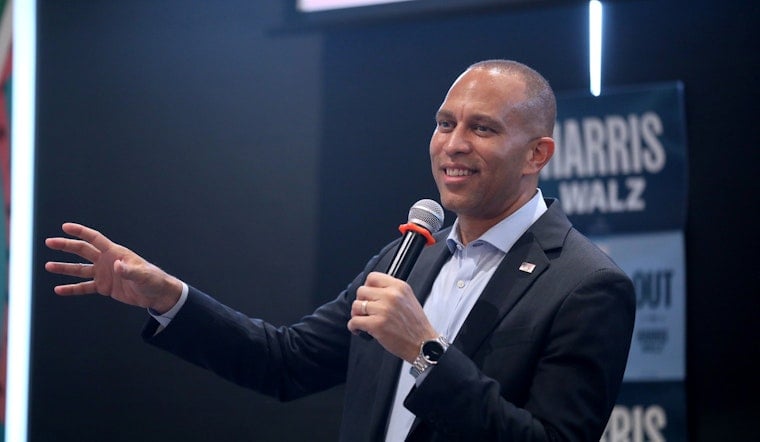
House Minority Leader Hakeem Jeffries told NBC's Meet the Press on Sunday that he does not support the Democratic Socialists of America's agenda as the group has articulated it, and confirmed he has not cosponsored Medicare for All legislation introduced over the last several years — a stance that immediately drew fire from within his own party. The Brooklyn Democrat was pressed on whether he backs single-payer healthcare and whether DSA belongs in the Democratic coalition, and his answers landed like a gauntlet thrown at the party's left flank just months before the November midterms.
Jeffries said Democrats are focused on solving problems for hard-working American taxpayers, according to the New York Post, and he outlined a platform built around lowering the high cost of living and dramatically reforming Immigration and Customs Enforcement rather than restructuring the health insurance system. He also said he does not support defunding the police, abolishing the Senate, or open borders — drawing a clear line against several planks progressives have pushed. Separately, in his own Meet the Press interview reviewed by the Washington Times, Jeffries framed his healthcare strategy around restoring expanded Affordable Care Act tax credits and reversing Medicaid cuts, arguing Democrats must first fix damage from funding lapses that left more than 20 million people facing higher premiums.
A Reversal From His Own Voting Record
The remarks stand out because Jeffries himself cosponsored Medicare for All legislation from 2013 to 2021, including Rep. John Conyers' H.R. 676 and Rep. Pramila Jayapal's H.R. 1976, before dropping his cosponsorship after ascending to House Democratic leadership in 2023. In a 2019 statement documented on GovInfo, Jeffries had called the Medicare for All Act a bold and aspirational initiative to solve the national health coverage crisis. That history has fueled accusations that his current position is more about leadership optics than policy conviction.
As of June 2026, the Medicare for All Act had 114 cosponsors in the House, representing 53.8% of all House Democrats, according to Wikipedia, making single-payer support the majority stance within Jeffries' own caucus. The Congressional Medicare for All Caucus has maintained more than 50 formal House members since its 2018 founding. That math is central to why critics argue Jeffries is out of step with the lawmakers he leads.
Khanna and Progressive Voices Push Back Fast
Rep. Ro Khanna directly challenged Jeffries on the same broadcast, calling Medicare for All arguably the most important priority and urging Democratic leadership to allow a House floor vote on the measure, according to reporting cited by the Washington Examiner. Khanna argued that exploding health insurance costs are suppressing worker wages, noting the average worker's share of national income has fallen to 43%. Commentator Mehdi Hasan said the vast majority of Democrats across the country support Medicare for All and criticized Jeffries on social media, per the Post's account of the fallout.
Other progressive figures piled on. Krystal Ball criticized Jeffries, while Kyle Kulinski called for him to step down, saying Jeffries is hurting Democrats' chances of defeating what Kulinski described as MAGA fascism. Briahna Joy Gray noted that DSA members worked to elect candidates including Alexandria Ocasio-Cortez and Zohran, according to the Post's reporting, and Ocasio-Cortez along with other Squad members have tried for years to push House Democratic leadership further left. The Democratic Socialists of America itself remains a subject of debate within the party over whether its influence should grow or be resisted.
Campaign Cash Adds Fuel to the Fire
Progressive commentators have pointed to Jeffries' fundraising as evidence of donor influence. OpenSecrets campaign finance tracking reported in August 2026 shows Jeffries received $391,000 in campaign contributions from healthcare industry political action committees during the 2026 midterm cycle, and he was also the top House Democratic recipient of insurance industry PAC cash during the 2024 cycle. That financial backdrop has become a recurring talking point for critics who argue leadership's caution on single-payer tracks with its donor base rather than its voters.
National polling suggests the base is well to Jeffries' left on the underlying question. A Pew Research Center survey conducted in late 2025 found 90% of Democrats and Democratic-leaning independents believe the federal government has a responsibility to guarantee healthcare coverage, with 52% favoring a single national government program over a mix of private and public insurance. Across the entire U.S. adult population, 66% said the same. Meanwhile, the Affordable Care Act marketplace has been under strain: enrollment dropped by nearly 3 million people nationwide in 2026 as average monthly premiums surged 58% to $178 following the expiration of enhanced federal tax credits, according to KFF Health News, with average deductibles climbing 37% to nearly $3,800 annually.
The Price Tag Behind the Standoff
The budgetary debate underpinning Jeffries' caution traces back to a 2020 analysis by the Committee for a Responsible Federal Budget, which estimated a comprehensive Medicare for All proposal would cost between $2.5 trillion and $3.5 trillion per year on average over a decade. Some Medicare for All plans go further still, including free dental, vision and long-term care with no copayments or deductibles — benefits that would cost even more than typical Medicare for All estimates already project. That price tag lands against a backdrop of a roughly $2 trillion fiscal-year 2026 federal deficit, a figure moderates frequently invoke against restructuring the health insurance system wholesale.
Jeffries has framed his approach as pragmatic rather than ideological, saying he is excited about the slate of candidates running to flip House seats in November — a coalition the party expects to include progressives, New Dems and Blue Dogs alike. That balancing act echoes his posture in a Buffalo speech last month, where he vowed to gut a Trump-era Medicaid rule while again centering Medicaid and ACA subsidies rather than single-payer as the party's core healthcare pitch.
A Familiar Fight Close to Home
This is not the first flashpoint between Jeffries and the party's left this summer. In July, more than 100 left-leaning lawmakers and Democratic Socialists of America members sent leadership a joint letter demanding Jeffries and Senate Leader Chuck Schumer endorse abolishing ICE following two fatal enforcement incidents, a push Hoodline detailed in its report on the Brooklyn lefties' abolish-ICE demand. Jeffries rejected those calls then too, advocating instead for body camera mandates and judicial warrant requirements — a position consistent with the ICE reform stance he reiterated on Sunday.
The tension also runs through Jeffries' home turf in Brooklyn, where Democratic Socialist Zohran Mamdani secured the 2025 Democratic mayoral nomination on an aggressive public-investment platform even as Jeffries held off on endorsing him during the primary. Local allies like Brooklyn Council Member Chi Ossé have previously quashed speculation of a primary challenge against Jeffries himself, underscoring that even in his own backyard, the debate over how far left the party should move remains unresolved.





.jpg)