

























































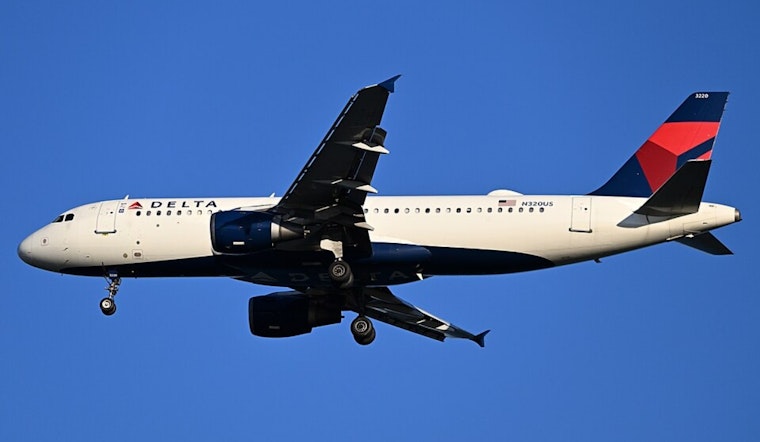
What was supposed to be the start of a long-haul trip to Rome instead landed Donatella Melissari in a courtroom fight with one of the world's biggest airlines.
Melissari, of Dearborn Heights, has filed suit against Delta Air Lines, saying she was left in a wheelchair at Detroit Metropolitan Wayne County Airport and suffered serious injuries when she tried to move on her own. The complaint says the July 2024 incident left her with a brain hemorrhage, a traumatic brain injury and a torn rotator cuff that required surgery. She is seeking more than $3 million in damages.
Melissari first filed the complaint in Wayne County Circuit Court on Jan. 14, but defendants removed the case to federal court last Tuesday, according to the federal docket on Justia. The case is listed as Melissari v. Delta Air Lines, Inc., No. 2:2026cv10642 in the U.S. District Court for the Eastern District of Michigan. Docket entries show counsel has entered appearances for Delta and the Wayne County Airport Authority.
What the complaint says
According to MLive, the complaint alleges Melissari was left alone in a wheelchair at DTW's McNamara Terminal for more than 90 minutes on July 20, 2024, while traveling from Detroit to Rome with a stop in Chicago. During that time, the lawsuit claims, her gate was changed.
The filing says that with no one arriving to assist, Melissari attempted to reach the new gate on her own, tripped and fell, and later required surgery for a torn rotator cuff along with treatment for head injuries. The suit seeks more than $3 million in damages, the outlet reports.
Delta and the airport push back
Defense attorneys have shifted the case into federal court and are arguing that the dispute falls under the Montreal Convention, an international treaty that can affect jurisdiction and damages in air-travel cases, according to MLive. That treaty argument is likely to be a key early battleground.
Delta declined to comment to reporters, citing the pending litigation. The Wayne County Airport Authority told the outlet it is not currently part of the lawsuit and has claimed immunity under Michigan law, even as attorneys for the defendants have appeared on the federal docket.
Why this matters for travelers
Delta's accessibility guidance tells customers to request wheelchair service at least 48 hours before travel and lays out what staff will and will not do at the gate and on board. For passengers who rely on that help to make tight connections or navigate sprawling terminals, those fine-print limits can matter a lot.
The broader issue has been simmering nationwide. Federal efforts to tighten protections for travelers who use wheelchairs have drawn legal challenges from several major carriers, per reporting by Mobility Management, underscoring ongoing tensions between regulators, airlines and disability advocates.
Legal implications
By invoking the Montreal Convention, the defendants are signaling they want the case evaluated under treaty rules rather than a broader mix of state-law claims. Legal reporting has noted that the treaty can narrow the routes available to plaintiffs and, in some instances, displace state-law theories altogether.
A recent decision highlighted in Law360 shows how similar treaty arguments have helped airlines limit or reshape claims in analogous wheelchair-fall cases. Legal analysts say the Eastern District of Michigan's handling of removal and preemption issues will be crucial in determining what options Melissari ultimately has in court.
The case remains pending in the U.S. District Court for the Eastern District of Michigan, where the federal docket reflects removal and early filings but no dispositive rulings so far, according to Justia. Advocates for travelers with disabilities say lawsuits like this one are being closely watched as a test of how well airlines' written accessibility policies line up with what actually happens in crowded terminals at major hubs.





