

























































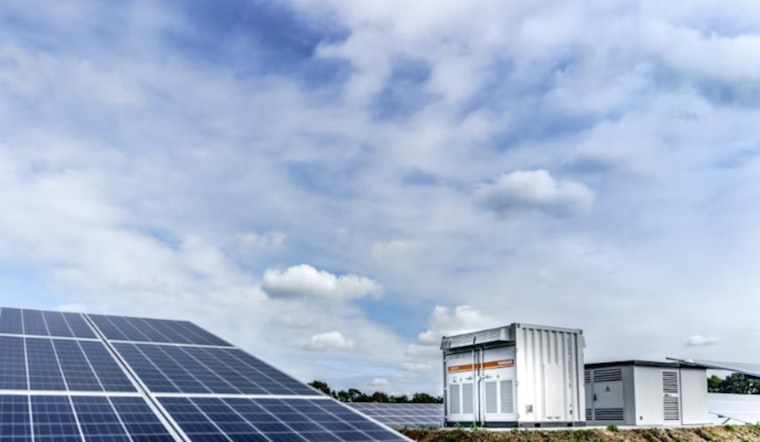
Arizona muscled its way into the top tier of U.S. battery storage in 2025, with utility-scale capacity jumping roughly 129 percent and the state’s total hitting about 19 gigawatt-hours. That kind of one-year leap pushed Arizona into the top three markets, trailing only California and Texas, and left the state dotted with some of the largest grid-scale batteries now being built. Local officials say the wave of projects is meant to keep the lights on during brutal summers while spinning off construction jobs and long-term tax revenue.
Record Year Nationwide, Big Role For Arizona
According to the Energy Storage Market Outlook Q1 2026 from Benchmark Mineral Intelligence and the Solar Energy Industries Association, the U.S. installed a record 57.6 gigawatt-hours of new battery storage in 2025, roughly a 30 percent jump over 2024, bringing utility-scale capacity to nearly 137 GWh. The report projects that more than 600 GWh of storage could be online by 2030, a forecast that has developers scrambling for land, hardware and long-term offtake deals. That national momentum is a big part of why Arizona drew so many multi-hundred-megawatt projects last year.
Mega Projects Driving The Surge
Longroad Energy’s Sun Streams 4 clocks in as a roughly 300 MW / 1,200 MWh solar-plus-storage project in Maricopa County, according to Longroad Energy. Recurrent Energy’s Papago Storage, also pegged at about 300 MW / 1,200 MWh, sits just west of Tonopah and reached commercial operations in 2025, per Recurrent Energy. The Scatter Wash complex, at about 255 MW / 1,020 MWh and developed by Strata Clean Energy before being sold to Copenhagen Infrastructure Partners, along with EDP Renewables’ 200 MW / 800 MWh Flatland project, further swelled the state’s pipeline, according to Energy Storage News.
“It really comes down to market dynamics,” Joan White, SEIA’s senior director of storage and interconnection policy, told KJZZ, pointing to falling storage costs and surging demand from data centers and utilities as key drivers. Industry groups and developers argue that a cocktail of federal tax incentives, local power purchase agreements and fast-rising electricity demand finally made the math work for building big in 2025.
The construction boom pairs neatly with new manufacturing moves in the state. LG Energy Solution’s Queen Creek complex and other local battery investments promise a closer-to-home supply chain for cells and packs, which in turn could help Arizona’s job market and installers, as reported in a battery plant in Queen Creek. Broader supply-chain shifts, including some cell lines retooling from EVs to stationary storage, have also helped developers secure equipment and speed up construction timelines, according to Utility Dive.
Not everyone is cheering the rapid expansion. Community groups in several areas have raised safety and land-use concerns, especially after high-profile battery fires elsewhere triggered local pushback. Questions around thermal runaway risks and long-term decommissioning are still very much on the table for regulators and utilities, who point to strict siting rules and monitoring requirements as key safeguards, according to reporting by AP News.
Arizona’s battery boom already has clear local winners, from landowners and contractors to utilities, and it has reshaped planning debates at the Arizona Corporation Commission and city councils across the Valley. For a closer look at the state-level numbers and marquee projects behind the trend, see the coverage from the Phoenix Business Journal. Analysts say the next 12 to 18 months will reveal whether all this new capacity can tame seasonal price spikes and how quickly it shows up as lower bills and more stable service.





