

























































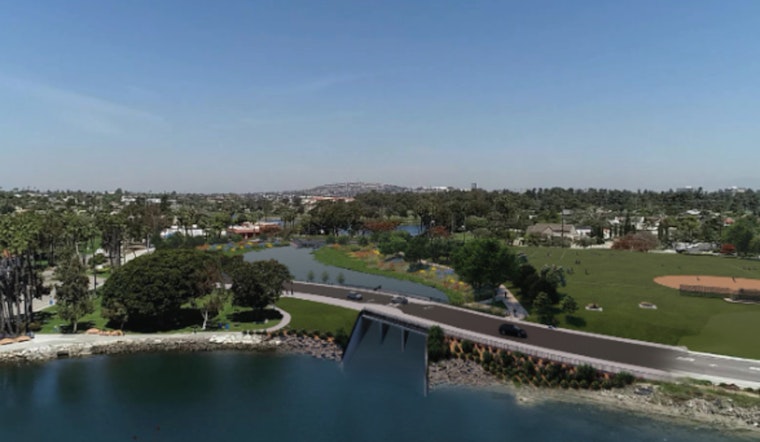
Street closures around Long Beach’s Colorado Lagoon could finally ease up by summer, according to city officials, even as the massive open-channel restoration project continues without a firm end date. Crews keep running into old, unmapped utilities and asbestos-containing materials while digging for a sewer siphon and bridge foundations, forcing repeated work stoppages and safety checks. For nearby residents, the drawn-out construction has meant constant detours, construction noise, and a lot of second-guessing about when this will actually wrap up.
Town hall update and critical pipe work
At a Feb. 25 town hall, city engineers told residents that crews are in the middle of installing a complex sewer siphon beneath the new Colorado Street bridge and are aiming to finish the pipe system so Eliot and Colorado streets can be repaved this summer. Project consultant Michelle Harati told the Long Beach Post that workers have run into unmapped utility lines "17 to 20 times," and said many of those older pipes were lined with asbestos, which triggers testing, tagging, bagging, and tightly controlled disposal. Drivers have been diverted to Seventh Street, Anaheim Street, and Bellflower Boulevard, while a temporary pedestrian path has served as the only way through the area for people on foot, as reported by the Long Beach Post.
How the city is handling asbestos
City documents show asbestos-containing materials were flagged in pre-construction surveys and are commonly found in older utility lines and historic fill. The city's asbestos FAQ spells out the drill: crews must stop work, conduct surveys and sampling, submit abatement plans to regulators, and bring in licensed abatement contractors who are overseen by certified consultants. As of Dec. 20, 2024, those materials had racked up roughly $600,000 in abatement costs plus $166,000 for consultant services. City officials say air-monitoring results show no airborne asbestos fibers and that cleanup has followed regulatory requirements, according to the City of Long Beach.
Budget overruns and a moving finish line
The Long Beach Post reports the city has spent at least $1.5 million on asbestos surveying and abatement as work continued into 2026, and that the project is at least $4 million over its original roughly $32 million budget. The restoration effort, which began in 2010 and is intended to carve out a roughly 12-foot-deep tidal channel between the 18-acre lagoon and Alamitos Bay, was originally scheduled to finish in March 2024 but has been postponed multiple times. Officials told residents they hope to complete the siphon and reopen the streets by summer, while warning that more buried surprises could still push that date back, according to the Long Beach Post.
What drivers and neighbors are feeling
Neighbors at the town hall questioned the latest schedule, pointing to earlier delays, change orders, and worker complaints that bogged down previous phases of the project. Local coverage has tracked asbestos discoveries, bad weather, and unexpected utilities that forced extra work and expanded detours onto streets such as Park Avenue to 7th Street or 6th Street. Even with a temporary pedestrian path in place, the closures have reshaped local traffic and fueled calls for firmer timelines and more frequent updates, as reported by Longbeachize.
Next steps for the lagoon and the shoreline
City project pages lay out the technical goals: opening up the existing 900-foot concrete box culvert to daylight, creating roughly 3.4 acres of new subtidal habitat, and improving tidal exchange for the 18-acre Colorado Lagoon. Documents note that crews still need to decommission the lagoon’s small culvert and finish excavation up to the Colorado Street bridge before the open channel can go live, and they acknowledge that timelines remain exposed to more buried utilities, hazardous finds, and bouts of bad weather. For updated maps, schedules, and community notices, residents can check the project page at the City of Long Beach.





