

























































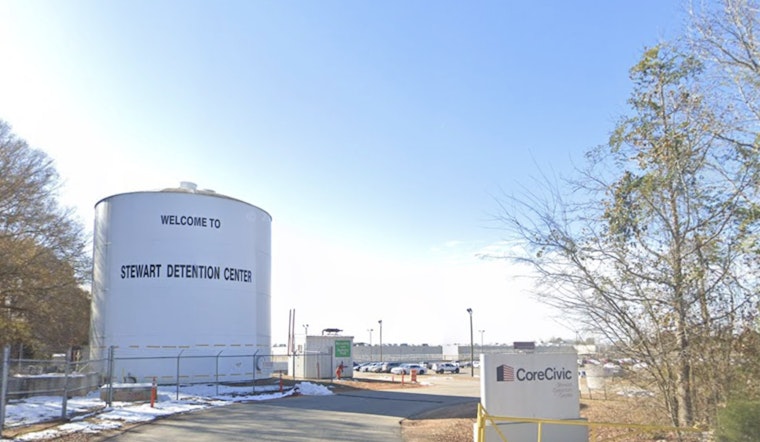
On Thursday, March 12, a woman who had helped federal investigators expose sexual abuse at the now-closed FCI Dublin was pulled from the boarding line at Hartsfield–Jackson Atlanta International Airport by ICE officers as she prepared to fly home. She was taken to Stewart Detention Center in Lumpkin, Georgia, and her attorney says she was deported days later to Matamoros, Mexico. Her removal has dragged an old fight back into the spotlight: survivors who cooperate with criminal probes say they should not pay for that cooperation with their immigration status.
According to WABE, the woman, identified only as Celia, had flown to Atlanta to attend her stepson’s military graduation. She was boarding her return flight when gate agents called her to the counter and ICE officers arrested her. In audio Celia shared with her attorney, she says she told officers she had a pending U-visa, and that supervisors told agents she had “a final deportation” on her record and could be removed despite the pending application.
Her lawyer, Susan Beatty, says she filed an emergency request with ICE in Atlanta asking for a stay of removal. She later learned that Celia had been transferred to Stewart and then deported to Matamoros. In a phone call Beatty shared, Celia described Stewart as cramped and cold and said she slept on a plastic “boat” on the floor. Stewart is a large ICE detention facility in Lumpkin that typically holds roughly 1,700 to 1,900 people on any given day.
How a U-visa Is Supposed to Protect Survivors
The U-visa is a temporary immigration status Congress created to encourage victims of certain crimes to work with law enforcement by offering a path to work authorization and, eventually, lawful status. USCIS explains that a properly filed petition must include Form I-918 and Supplement B, a certification completed by a law enforcement agency. That certification is a required and central part of the application.
In practice, the safety net is thinner than it looks. Backlogs, annual caps and agency discretion mean that even with a certification or a pending petition, removal is not automatically halted, advocates and policy groups point out. Human Rights Watch and other organizations have argued for years that slow case processing and enforcement priorities can leave cooperating survivors exposed to deportation while their applications sit in line.
Where Celia’s Case Fits in the Dublin Prison Scandal
Celia was among the women who reported sexual abuse at FCI Dublin, a federal women’s prison that has become the focus of a sweeping investigation and a string of criminal cases. The Department of Justice has charged former Dublin employees, and the federal government has agreed to settlements and acknowledged systemic failures at the facility as part of the wider fallout. The DOJ has lodged indictments in several cases, and AP coverage details settlements and the prison’s closure.
Advocates Say the Arrest Fits a Disturbing Pattern
Advocacy groups and legal clinics that work with Dublin survivors say Celia’s situation is not a one-off. Community organizations have warned for years that immigrant survivors and witnesses have been detained or deported even after stepping forward to aid prosecutions.
In one high-profile appeal, a coalition of more than 120 organizations called on ICE to stop detaining and deporting noncitizen survivors and witnesses of staff sexual abuse at Dublin and to provide concrete protections for those who came forward. Centro Legal de la Raza
Celia’s case also highlights some dry-sounding but very real legal questions: whether law enforcement agencies and prosecutors that sign off on U-visa certifications can do more to flag those cases to ICE, and whether immigration authorities will agree to honor interim protections while petitions are still pending. Beatty says federal prosecutors and others have already been in contact with the Department of Homeland Security about Celia’s case, and she continues to pursue legal relief for her client.
The deportation lays bare a continuing tension between criminal accountability and immigration enforcement. Survivors who help put abusers on trial say they often lose the one protection that could allow them to remain in the country, and critics argue that gap in protection is a justice problem lawmakers and federal agencies have yet to fix.





