

























































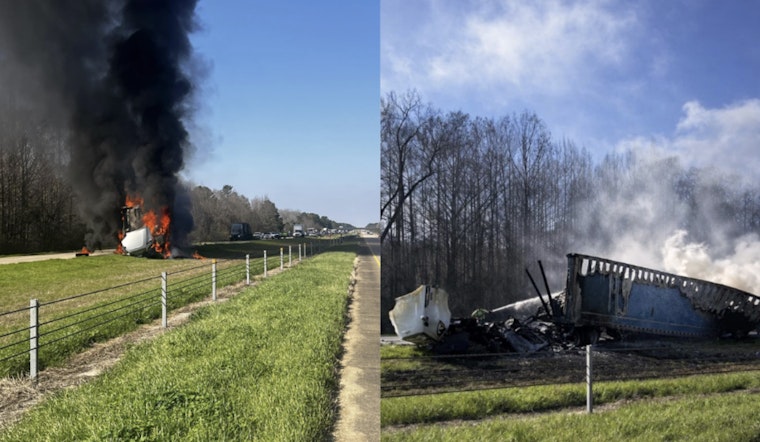
On Thursday, Feb. 12, a routine tire change on Interstate 49 in Natchitoches Parish turned tragic when a second tractor-trailer slammed into a parked rig, killing 25-year-old Dejuan Dickerson of Highland Park, Michigan. The collision near milepost 140 sparked a fire that engulfed one of the trucks and shut down both northbound and southbound lanes for hours while crews battled flames and cleared wreckage. The driver of the striking truck suffered only minor injuries as investigators worked the scene.
What Happened On I-49
According to KSLA, Louisiana State Police and Natchitoches Parish deputies responded just after 1:40 p.m. Initial reports indicate that a 2025 Freightliner had stopped on the southbound shoulder so the driver could change a flat tire when a 2023 Freightliner drifted off the roadway and struck the parked truck on the left side.
Local station KALB reported that Dickerson was pronounced dead at the scene, while the driver of the moving truck was evaluated and treated for minor injuries. Both directions of I-49 were shut down for hours as fire crews, troopers and investigators worked to put out the blaze, clear debris and document the crash.
Why Parked Rigs Become A "Sitting Duck"
Highways are built with what engineers call a "clear zone" - that open stretch beyond the travel lanes that is supposed to give drivers who leave the roadway room to recover or come to a stop. Put a stopped 18-wheeler in that space and it can quickly turn into a deadly obstacle.
In an analysis published by the Legal Examiner, attorney Jed Cain of Herman, Katz, Gisleson & Cain described a fully loaded tractor-trailer parked on or near the shoulder as a potential "sitting duck" situation. With traffic moving at interstate speeds, drivers who drift off the road have little time or space to react. Guidance from the Federal Highway Administration on clear zones underscores how critical an unobstructed roadside is for keeping those mistakes from turning fatal.
The Law And Federal Rules
Federal safety rules spell out what commercial drivers must do if they stop on a highway or its shoulder. When a truck stops on a traveled portion of the roadway or on the shoulder, drivers are required to immediately turn on hazard-warning flashers and, in most cases, place approved warning devices such as three reflective triangles within 10 minutes. The exact placement distances and requirements are detailed in 49 C.F.R. § 392.22.
Louisiana law adds another layer. State statute La. R.S. 32:296 limits shoulder use on interstates to true emergencies, allowing drivers to pull onto the shoulder only when it is made necessary by an emergency. That rule can come into play not just for traffic citations but also when courts later sort out civil liability after a serious crash.
How Drivers Can Reduce Risk
Safety experts stress that regular drivers have more power than they think to avoid becoming part of a scene like the one on I-49. They recommend leaving generous following distance so there is time to react, slowing down early and changing lanes when approaching any disabled vehicle, and staying alert for hazard lights and reflective triangles, especially at night or on curves where a stopped truck may be hidden until the last second.
Trucking companies and industry safety manuals urge professional drivers to avoid shoulder stops unless the vehicle is truly disabled and there is no safer option. When a stop is unavoidable, drivers are instructed to deploy the federally required warning devices and keep hazard flashers on until the situation is secure, in line with the federal rules and industry guidance noted above.
Prosecutors in the Natchitoches case say charges are pending against the surviving driver while troopers and investigators work to determine whether the shoulder stop qualified as an emergency under state law, and whether other factors such as visibility or warning-device use played a role in the fatal outcome. Authorities have not yet released a full investigative report, but officials and safety advocates say the crash is a stark reminder of how quickly a seemingly routine roadside task can turn deadly on a high-speed interstate.





