

























































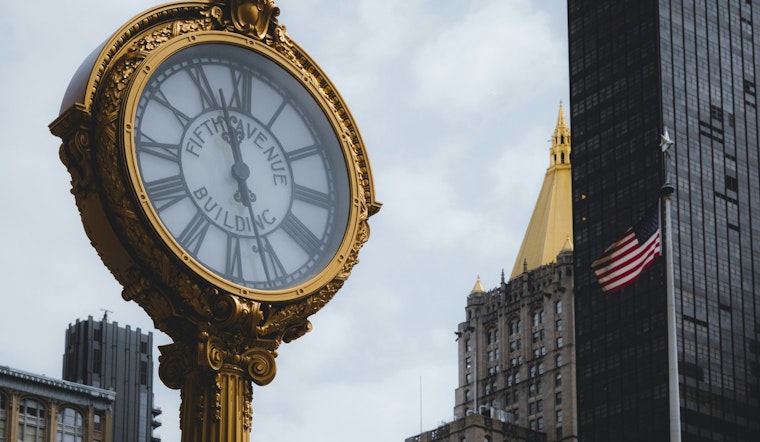
New York’s latest push to stop the twice-yearly clock shuffle is stalled at the border, because five neighboring states and Congress all have to play along first. With clocks set to “spring forward” this Sunday, the issue feels urgent for commuters and businesses that cross state lines, but for now everyone should still plan on the usual time change.
Senate bill S3380, first introduced Jan. 27, 2025, would lock New York into Eastern Daylight Time year-round. The measure is written so it cannot actually take effect unless nearby states pass matching laws and federal rules change, according to the New York State Senate. Sponsors include Sens. Griffo, O’Mara and Walczyk, and the bill says New York could enter a compact with its neighbors once federal law allows permanent daylight saving time. Versions of the idea have been circulating in Albany since 2019.
For now, Congress still controls whether states can stay on daylight saving time all year. Most state proposals are written so they only kick in if the Uniform Time Act is changed, according to the National Conference of State Legislatures. States are already allowed to stick with permanent standard time, as Arizona and Hawaii do. Locking in daylight saving time, though, takes either a federal change or coordinated action across state lines, which is why New York’s bill includes a multi-state trigger.
What Neighboring States Are Doing
New York’s measure specifically looks to Connecticut, Massachusetts, New Jersey, Pennsylvania and Vermont, but none has passed an identical law so far, Fox 5 NY reported. In Connecticut, Rep. Kurt Vail has repeatedly pushed a shift to Atlantic Standard Time that would depend on neighboring states and federal approval, according to CT Insider. New Jersey advanced a daylight saving bill through committee as recently as November, per Open States. Massachusetts, Pennsylvania and Vermont have put forward related measures or resolutions, but none has produced the exact multi-state compact New York’s law would require.
That patchwork effort fits a broader national pattern. In recent years many states have passed or debated measures to adopt permanent daylight saving time if Congress allows it, and several have added language that they will only move once neighboring states do the same, the National Conference of State Legislatures notes. Supporters say the regional coordination clause is less red tape and more common sense, meant to avoid a tangle of conflicting time rules that could scramble transit schedules, shipping, broadcast times and school days.
Health, Polling And Politics
Public opinion has been drifting away from the ritual clock change. A Gallup survey conducted March 4, 2025, found that 54% of Americans wanted to get rid of daylight saving time, with many favoring a single permanent time instead of the twice-yearly switch, according to Gallup. The science is not exactly cheering on permanent daylight saving either. A 2025 circadian health model published in PNAS suggests that permanent standard time could bring larger overall health benefits than permanent daylight saving time, a trade-off some lawmakers have cited as they weigh competing priorities (see PNAS).
Legal Road Map
On paper, S3380 is built to sit quietly on the books until two things happen. First, Congress would have to change federal rules, or the five neighboring states named in the bill would need to pass matching laws. Only then could New York flip the switch to year-round daylight saving time without creating a checkerboard of different time rules across the region, according to the New York State Senate. Until that kind of coordination is in place, these proposals function mostly as a signal to Congress and other states rather than as immediate policy shifts, and they are designed to avoid sudden disruptions to cross-state commuting, scheduling and commerce.
Bottom line: unless Congress acts or the five neighboring states pass identical measures, New York will still “spring forward” this Sunday and stick with the twice-yearly clock change. Lawmakers say the fight over what time it should be is far from settled, but for most New Yorkers the practical move is still simple: set the clocks and, if necessary, start nudging bedtimes a little earlier.





