

























































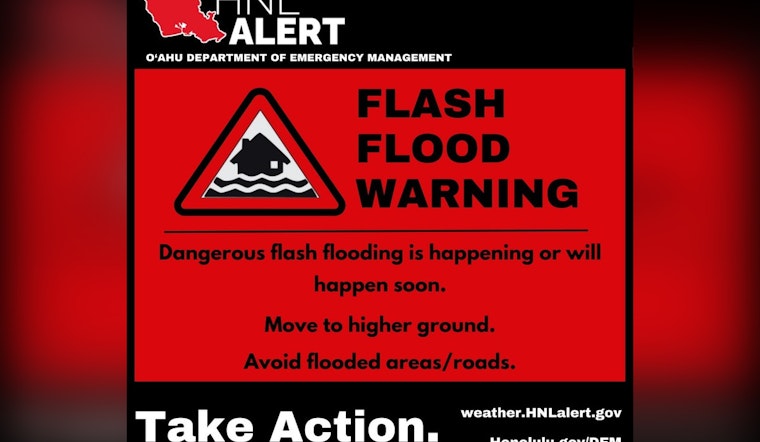
Phones across Oahu lit up Friday as a flash flood warning went out for parts of the island, with emergency officials telling residents in no uncertain terms to head for higher ground and stay off flooded streets. After a week of elevated flood threat and already soaked soils, even brief bursts of heavy rain are primed to trigger dangerous runoff. Drivers are being warned to brace for sudden road closures and standing water that can turn the usual commute into a no-go zone in minutes.
HNL Alert: Flash Flood Warning Issued - Take Action! Dangerous flash flooding is happening or will happen soon. Move to higher ground. Avoid flooded areas/roads. View forecast details at https://t.co/rWQABuBXKc. Monitor alert.h https://t.co/zGMJ36S28Q https://t.co/WVu2bvEkin
— Oahu Emergency Mgmt. (@Oahu_DEM) March 20, 2026
The HNL Alert, posted by the Oahu Department of Emergency Management on X, bluntly warned, "Move to higher ground. Avoid flooded areas/roads," and pointed residents to local forecast details. Oahu Emergency Mgmt. on X pushed the warning through the city mass-notification system, and officials stressed that anyone in flood-prone neighborhoods should treat it as a call to act immediately, not something to file away for later.
National Weather Service updates
The National Weather Service in Honolulu has issued flash flood warnings and is tracking slow-moving bands of heavy showers capable of producing rapid runoff across parts of Oahu, according to the National Weather Service in Honolulu. Forecasters caution that localized downpours can quickly push up stream and gulch levels, turning streets and underpasses into fast-moving water that threatens life and property. If a flash flood warning covers your area, NWS guidance is straightforward: get to higher ground right away and avoid traveling through any flooded roadway.
Where the danger is highest
Flood-prone corridors, including windward slopes, stream channels and low-lying urban neighborhoods, are at the greatest risk, especially where repeated storms have already saturated the ground. Local outlets have reported closures and ponding on roads across the islands as agencies brace for additional heavy rain, according to Spectrum News. Motorists are being urged to assume that secondary roads and underpasses can flood with very little warning and to plan alternate routes in advance when possible.
How to stay safe right now
Officials are repeating the same bottom line: follow the HNL Alert instructions, move to the highest available ground, do not drive through standing or moving floodwater, and keep phones charged so you can receive updated alerts. The City and County of Honolulu operates the HNL Alert sign-up and maintains flood safety guidance at honolulu.gov/dem. The National Weather Service "Turn Around, Don't Drown" slogan still applies in every storm: if you see water over the road, turn back and find another way. Never try to power through it.
Conditions can shift fast in a flash flood event, so if you are inside a warned zone, move now and call 911 for emergencies. You can enroll in the city mass-notification system at HNL Alert and keep an eye on National Weather Service updates and official city channels until the warning is lifted.





