

























































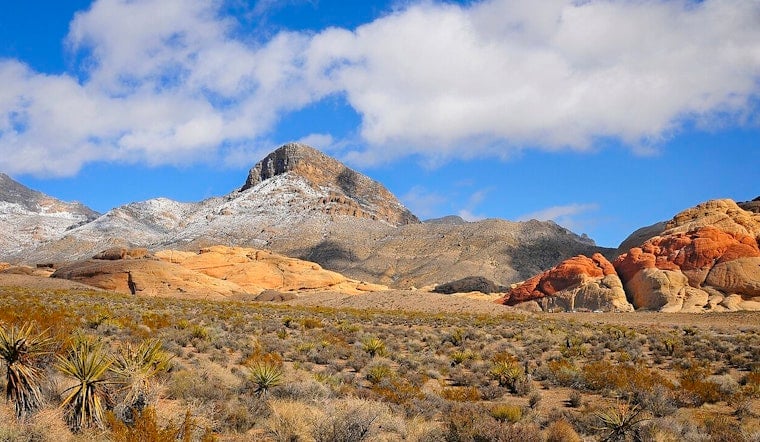
Las Vegas water officials and conservation advocates are lining up against a pumped-storage hydropower project proposed for the top of Blue Diamond Hill, just outside Red Rock Canyon. The developer insists the closed-loop system would quietly store water in two sealed reservoirs and churn out reliable power, but critics say the water demands and habitat risks do not square with Southern Nevada's hard-fought conservation goals.
The Desert Bloom Energy Storage proposal calls for two reservoirs, each holding about 4,900 acre-feet of water, paired with a 450-megawatt powerhouse and a short transmission tie. The company pegs annual generation at roughly 1,170 gigawatt-hours, according to the Federal Register. The Federal Energy Regulatory Commission notice stresses that a preliminary permit only secures a priority spot to study the idea and does not greenlight construction or any land-disturbing activity.
Even with a “closed-loop” design, the project would still need nearly 9,800 acre-feet of water to initially fill the reservoirs and offset evaporation, a number that has set off alarms among local water managers and environmental groups. The energy output pencils out to roughly 108,000 U.S. households using the Energy Information Administration’s average residential consumption, a sizable boost in power that comes with equally sizable questions. Local officials have also highlighted the cost and complexity of building many miles of pipeline and pumping stations to move water up the hill, with local coverage reporting that those expenses would fall on the developer or regional utilities, as summarized by The Nevada Independent.
Blue Diamond Hill has been floated as a pumped-storage site since the 1990s. Earlier versions of the idea went through environmental review but never broke ground, and regulators have repeatedly closed or scaled back subsequent efforts when developers failed to move into construction. Industry trackers and legal summaries point to a long paper trail of applications, terminations and fresh filings at the site, compiled by Global Energy Monitor in its review of FERC dockets.
Water, Wildlife And The Law
Federal land managers and conservation groups say the project footprint lies in a particularly sensitive slice of the Mojave Desert. Reporting on the proposal notes that the Bureau of Land Management, which oversees the public lands near Red Rock, has raised concerns about threatened Mojave desert tortoise habitat and several sensitive plant species, issues that would trigger extensive environmental review for any license or right-of-way. In filings and interviews cited by local outlets, Southern Nevada water officials have told regulators the project "does not align" with regional conservation priorities, while the Bureau of Reclamation has said it will not approve water use for the reservoirs unless the developer can secure valid water rights, a legal hurdle that could decide the project’s fate.
What Comes Next
For now, the developer only has a preliminary permit application, which offers time and priority to study feasibility. It does not authorize moving dirt, building reservoirs or diverting water, all of which would require additional approvals and environmental signoffs. The Federal Energy Regulatory Commission has requested public comment and will weigh environmental filings, interventions and study plans as the company works toward a full license application, according to the commission’s notice and reporting by Circle of Blue.
Developers argue that pumped storage can deliver long-duration, dispatchable clean energy that helps balance the grid. Regional water and conservation managers counter that core questions about where the fill water would come from, who would pay for the pipelines and pumping stations, and how fragile desert habitat would be protected must be settled before the Blue Diamond plan moves beyond the drawing board. Local advocates, elected officials and the agencies that manage water and public lands are all expected to scrutinize the regulatory record as the study period unfolds.




