

























































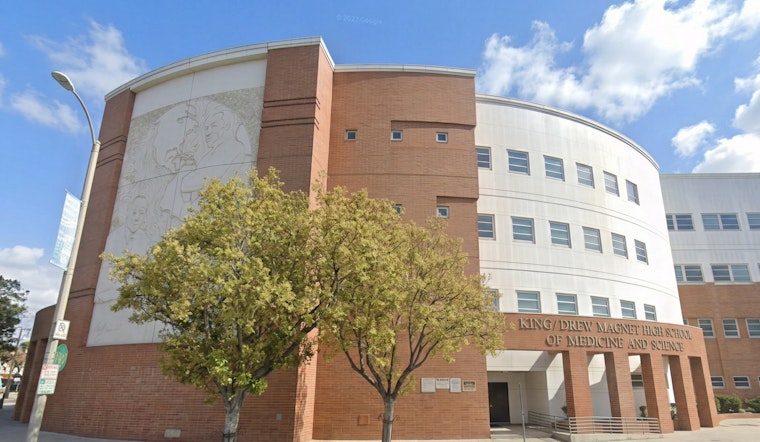
King/Drew Magnet High School of Medicine and Science has spent four decades turning students from Willowbrook and Compton into future physicians, oncologists, neurosurgeons, and ER specialists. Its students shadow doctors at UCLA's Ronald Reagan Medical Center. They practice phlebotomy on mannequins. They graduate at rates approaching 100% and receive UC system admissions letters by the hundreds. So it's at least a little ironic that the LA County Department of Public Health ordered the cafeteria closed yesterday, March 25, 2026, citing a major vermin violation — evidence of rodents in a building full of aspiring healthcare professionals. LAUSD says it's less alarming than it sounds, and the district's response has been swift. But their own staff acknowledges that in a system managing 684 school kitchens, this is not exactly a rare occurrence.
What the Health Department Found
The LA County Department of Public Health flagged an 11-point major vermin violation — the category that triggers mandatory immediate closure under county protocols — along with lower-level findings for plumbing, equipment condition, floors, ceilings, and ventilation. Under county inspection guidelines, a major vermin finding constitutes an imminent health hazard: the presence of pests "evidenced by actual live bodies, fresh droppings or vomitus, urine stains, or gnaw marks" that could result in food or equipment contamination, per the LA County Department of Public Health. That's the standard the county applied here. The cafeteria was closed.
What LAUSD Says
Hoodline reached Soniya Perl of the LAUSD Food Services Division, who offered the district's account. "They didn't find any rodents," Perl said. "They found a few little droppings." She said the Health Department characterized the closure as "just out of an abundance of caution," and emphasized that there is no evidence food was contaminated or that students were exposed to any health risk. "We are very diligent at looking at our cartons, any openings in our food containers," she said.
As for how pest evidence ends up in a school kitchen at all — Perl was candid. "Because we're a kitchen, sometimes the doors get left open. We have water and food — the types of things a pest is looking for." She was quick to add: "We always take it very seriously." Whether "always" fully squares with "it's not an anomaly" — also her words — is something the district may want to sit with. When asked to characterize the scale of the problem, Perl said plainly: "It's not an anomaly. It's not a huge infestation." That's meant as reassurance, but it does raise the question of how often this kind of thing happens across 684 facilities, and how consistently families are informed when it does.
Perl said this closure came from one of two routine annual inspections the district pays for, not a community complaint. "We pay for two annual inspections from the Health Department. In addition to internal inspections and protocols as well." She noted that cafeteria workers do daily walkthroughs — "they look behind ovens and behind doors" — so the finding catching the district off guard suggests either those checks missed something or conditions changed quickly between walkthroughs.
The Response Plan
Students are being fed from the central kitchen in the meantime. "We're getting food from our central kitchen for the next few days," Perl said — a contingency the district apparently runs smoothly for all manner of disruptions, from sewage backups to hot water failures to pest findings. "We routinely have closures for various reasons. We have a system in place to handle this kind of thing." The plan at King/Drew is a weekend deep clean followed by a reinspection early next week. "We wait for a couple of days to make sure there is absolutely no activity. Then when we are absolutely sure, we call for a re-inspection."
On whether parents were notified — Perl didn't directly answer. The framing of her response suggested closures are treated as operational matters rather than community communications events: "We have a system in place to handle this kind of thing." It's a reasonable position for a district managing hundreds of kitchens. It's also the kind of answer that may not fully satisfy parents who'd want to know their child's cafeteria was temporarily closed for rodent-related evidence, even if the droppings were few.
The School Had No Comment
Hoodline reached Principal Reginald Brookens' office directly. A representative there declined, offering only: "We have no comment." LAUSD's broader communications office has also been contacted; this story will be updated if a response is received.
The School Behind the Story
King/Drew's cafeteria closure would be a routine footnote in almost any other school. Here, context makes it more resonant. The school was founded in 1982 from a direct community act of determination — a small magnet program in temporary bungalows adjacent to the Martin Luther King Jr./Drew Medical Center, built specifically to create educational and healthcare pathways for students in one of South LA's most underserved neighborhoods, as described by Los Angeles Magazine. Today it sits on a purpose-built campus next to Charles R. Drew University and the Martin Luther King Jr. Community Hospital, and sends juniors on weekly rotations through clinical settings at UCLA, the VA, and Watts Health Center.
About 90% of its roughly 1,300 students qualify as economically disadvantaged, per SchoolDigger, and LAUSD's universal free meal program means the cafeteria is a genuine daily lifeline for many of them — not just a convenience. Recent graduating classes have secured nearly $8 million in scholarships. The school approaches a 100% graduation rate. It has been recognized as a California Distinguished School, as noted by 2 Urban Girls. It is, by every available measure, doing extraordinary things for the community it was built to serve. A few mouse droppings in the kitchen do not diminish that. But a school whose entire identity is built around health deserves a cafeteria that reflects the same standard — and the district has said it will deliver that. We'll see what the reinspection says.
The cafeteria's current status can be verified at the LA County Environmental Health Services portal under facility ID FA0161662. King/Drew can be reached at (323) 566-0420.





