

























































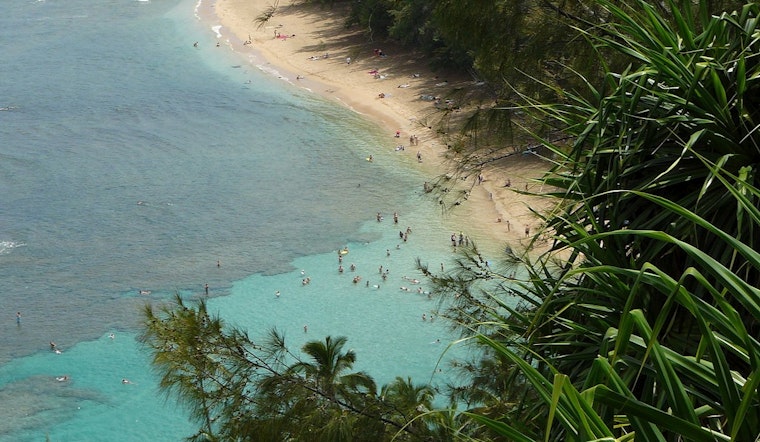
Kauaʻi residents who feel squeezed out of their own shoreline may finally be getting some breathing room. A beloved but badly congested stretch of the North Shore is on track to shift from county control into the state park system, a move locals hope will put everyday access for residents back at the front of the line.
County-owned Hāʻena Beach Park and the neighboring Maniniholo Dry Cave are set to be folded into Hāʻena State Park if the governor signs off on a recommendation from the Board of Land and Natural Resources. The change would bring one of the island’s most heavily visited beach corridors under a single management system instead of the current county-state patchwork.
At its Feb. 27 meeting, the Board of Land and Natural Resources voted to authorize the state’s acquisition of the five-acre Hāʻena Beach Park parcel and the three-acre Maniniholo Dry Cave, and recommended an executive order that would formally set the lands aside for park use, according to the DLNR board packet. The document also notes the project is exempt from preparing an environmental assessment and lays out the legal steps for adding the county parcels to Hāʻena State Park.
This latest move follows a unanimous Kauaʻi County Council vote on Nov. 26, 2025 to transfer the parcels to the state. Kauaʻi Mayor Derek Kawakami has said he intends to finish the handover before leaving office, as reported by KENS5/Associated Press. Supporters say the goal is to unify management along the Na Pali-fronting shoreline and better balance the daily tug-of-war between residents and visitors.
What State Management Would Look Like
Bringing Hāʻena Beach Park and Maniniholo Dry Cave into Hāʻena State Park would plug them into a system that is already built around controlling crowds and funding stewardship. Hāʻena State Park uses an integrated access setup that includes advance reservations, a park-and-ride shuttle and on-site staff to cap daily numbers and manage traffic.
The community-based management currently operating in Hāʻena is run by the Hanalei Initiative and the steward group Hui Makaʻāinana o Makana. Hawaiʻi State Parks has laid out reservation rules and resident-free entry policies designed to keep space for locals even as visitors pour in. Advocates say those same tools could be extended across the county parcels once they are pulled into the state system.
Numbers Show Just How Packed It Gets
The statistics behind Hāʻena’s crowds explain why residents have been pushing for change. Hāʻena Beach Park has roughly 40 parking stalls but has seen about 1,400 visitors a day over the Christmas holiday and roughly 800 a day during some summer stretches. Before tighter caps and reservations were introduced, Hāʻena State Park itself drew as many as 3,000 people a day.
Kauaʻi police data cited in reporting show dozens of calls for service and hundreds of traffic citations tied to the park area in recent years. The daily reality is plenty of idling cars and not much room for people who actually live nearby.
“Backup from cars waiting for an open spot makes it difficult for local people to get to work,” Joel Guy, executive director of the Hanalei Initiative, told KENS5/Associated Press.
According to DLNR’s submission to the board, the parcels contain no recorded burial sites or environmentally hazardous materials. The document recommends folding them into Hāʻena State Park by executive order and details how responsibilities would shift during the transition. For roughly the first year, the county is expected to keep lifeguard coverage and basic maintenance going while the state and community partners assume full day-to-day management.
What Happens Next
The board’s recommendation now awaits the governor’s signature on an executive order. If it is approved, the Hāʻena Beach Park and Maniniholo Dry Cave parcels would be officially set aside to the Division of State Parks and become part of Hāʻena State Park.
Local leaders say the real test will be in the details. They want to keep the reservation and shuttle systems intact, along with resident-priority rules and community partnerships like the Hanalei Initiative, to restore everyday access while safeguarding cultural and natural sites.
The Hawaiʻi State Parks page for Hāʻena notes that residents receive free entry with ID while nonresident visitors must book reservations. Advocates say that basic framework is what keeps locals from being pushed to the margins.
For North Shore residents who have watched full lots and backed-up lanes slowly squeeze them from their own beach, the governor’s decision and how strictly resident-priority parking and shuttle capacity are enforced will determine whether this transfer feels like real relief or just another reshuffle. Officials say timelines and implementation details should become clearer in the coming weeks if the governor signs off on the board’s recommendation.



