

























































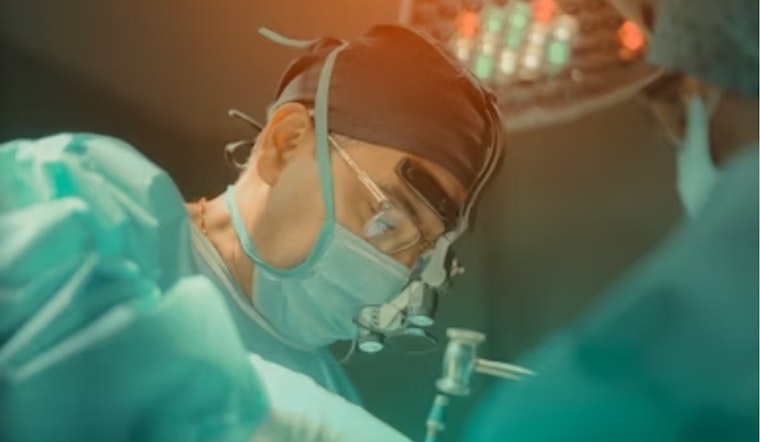
In Aurora, surgeons at UCHealth University of Colorado Hospital have implanted a brain-computer interface in higher-level areas of a 41-year-old patient’s cortex, a world-first approach that researchers say could help him control external devices and regain some sensation. The device sits beneath three small ports on the top of his skull and is designed to record single-neuron activity over an extended period. The patient, Brandon Patterson, who was left paralyzed after a 2017 crash, told reporters he felt his fingers move shortly after the operation.
As detailed by CU Anschutz, the team describes the surgery as Colorado’s first implanted brain-computer interface and says its physicians are among the first in the world to place arrays in “higher-level” cortical regions rather than the primary motor strip. Neurosurgeon Daniel Kramer called the work “an important step forward not only for this patient but for neuroscience as a whole,” and the university notes that the implant is expected to remain in place for years so researchers can gather long-term data. The goal is to translate complex brain signals into commands for robotic limbs, computer cursors and targeted sensory stimulation.
In an interview with CBS Colorado, Patterson and members of the surgical team walked through the device’s early impact and its hardware. The three skull ports can be connected to external electronics and, as Kramer explained, “each one of those can record one or even a couple of single neurons.” Patterson said he does not expect to walk again, but he hopes the technology will expand what he can do from his wheelchair, adding that he felt his fingers “moving just on their own” during initial testing. Researchers are already training computer decoders to map intention-linked patterns in his brain activity to cursor movement in controlled sessions.
Why targeting higher-level cortex matters
Most human BCI research so far has focused on the primary motor cortex, since its outputs have a more direct and easier-to-read link to muscle movement. Clinical reviews and long-running trials such as BrainGate document both those successes and the limits of motor-cortex implants when it comes to richer, coordinated behavior. Recording from higher-order cortical areas, regions involved in planning, decision-making and multisensory integration, may open a window onto more abstract and flexible signals that could support more natural movement and restored sensation. Work described in BrainGate trials shows how the field has been moving from simple cursor control toward more ambitious, long-duration implants.
What researchers will study
The CU team says it plans to collect years of neural data from Patterson to study how the brain represents complex tasks and to test stimulation of sensory regions that might help restore touch. That long-haul strategy is meant to capture day-to-day variability and to track how learning or decoder updates change performance over time, according to CU Anschutz. The investigators hope those insights will guide future devices aimed at spinal-cord injury, ALS, and other conditions that disconnect the brain from the body and the outside world.
The research is being carried out with outside engineering partners, including collaborators at Caltech and the University of Southern California, who are helping build analysis pipelines and next-generation decoders, according to PR Newswire. The collaboration reflects a broader trend in BCI work that mixes neurosurgery, machine learning and systems engineering in an effort to turn sparse neural signals into usable commands and sensory feedback. Patterson’s implant is designed to remain accessible for external upgrades and experiments over time.
Risks, limits and next steps
Researchers are quick to point out that long-term safety, signal stability and infection risk are still open questions when hardware stays in the brain for many years. Earlier teams have reported meaningful gains for participants, but they have also stressed the need for lengthy follow-up and for decoders that hold up as brain activity shifts from day to day. Recent first-in-human wireless and high-channel-count BCI studies highlight both the promise and the technical hurdles ahead. The CU group plans phased testing and close monitoring as it refines decoders and layers in sensory-stimulation trials, with patient safety framed as the top priority. Trials described by BME show how teams elsewhere are pushing toward less bulky, longer-term systems.
Data and privacy questions
In Colorado, the legal backdrop adds another twist. Lawmakers expanded the state’s privacy rules in 2024 so that neural data is treated as a sensitive category, which could influence who is allowed to access and analyze the signals this study collects. Ethicists and policy watchers warn that mental-privacy protections, data-retention rules and consent processes will need to keep pace with implants that record granular brain activity over years. As Popular Science and local reporting have noted, Colorado’s decision to classify neural data as sensitive set an early template for other jurisdictions and adds a new layer to research governance.
For now, Patterson’s focus is more personal than policy-heavy: greater independence and the chance of feeling his hands again. He told CBS Colorado he is excited to see what the technology can do and to help researchers learn what the brain can teach machines.





