

























































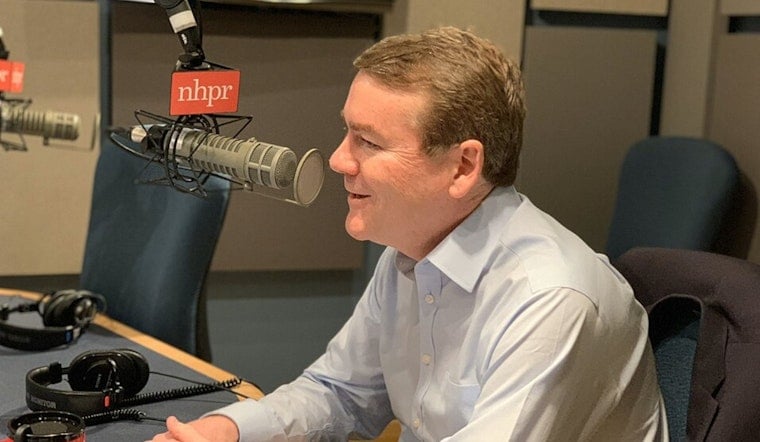
U.S. Sen. Michael Bennet and his campaign for Colorado governor have agreed to a fine and have formally admitted violating state campaign finance law, after regulators determined that his gubernatorial bid improperly used money from his federal Senate account to cover 2025 travel costs. The settlement closes out a monthslong dispute that trailed Bennet through his ultimately unsuccessful run for governor this year.
According to the Denver Gazette, Bennet, his campaign's registered agent, and Timothy Gebhardt, the state's campaign finance enforcement manager, all signed the settlement on July 21. The agreement still needs approval from Colorado's deputy secretary of state, and once it's approved, the administrative proceedings against Bennet's campaign will be dismissed. As part of the deal, Bennet and his campaign waived their right to appeal.
Inside the $7,433 Settlement
The penalty combines several separate violations tied to travel spending. Regulators classified 39 travel-related expenses as prohibited contributions from Bennet's Senate committee to his gubernatorial campaign, assessing a flat $100 penalty for each — $3,900 total — plus another $2,444.06 equal to 10 percent of the prohibited activity. A separate $1,089.77 penalty covers 27 of those travel expenses, made during the second and third quarters of 2025, that the campaign failed to report on time: a $200 flat fee plus $889.77, calculated as 5 percent of the late-reported activity. Bennet's campaign must pay the full $7,433.83 within 14 days of receiving an invoice from Colorado's Elections Division.
After the first complaint was filed against the campaign in September 2025, Bennet's team audited its own books and reimbursed his Senate account $24,440.59 in two separate payments — $17,386.94 and $7,053.65 — according to Colorado Politics. Bennet also tried to push the proceedings past the June 30 primary, but hearing officer Macon Cowles rejected that request in May, ruling that Colorado's campaign finance laws exist to give voters transparency before an election rather than accommodate a candidate's scheduling needs. The settlement states that the reimbursement cured the underlying violations, even though the Elections Division separately found that the campaign had failed to achieve substantial compliance with its legal obligations, which is why the fine still applies.
How the Complaint Began, and the Law Behind It
The dispute originated with complainant Alyssa Holladay, who filed multiple campaign finance complaints against Bennet's campaign in 2025. In her filing, Holladay pointed out that Bennet's Senate committee spent $142,000 during the second quarter of 2025 alone — including $17,494 across 92 travel expenditures — despite having no active Senate re-election campaign underway that year. Bennet had filed a Senate candidate affidavit back in March 2024, but didn't announce his run for governor until April 2025, the paper reported.
Colorado's ban on shifting money between federal and state campaign accounts traces back to Amendment 27, a 2002 constitutional amendment approved by 66 percent of voters that strictly limits candidate contributions, as Colorado Politics has reported. That amendment, now codified as Article XXVIII of the state constitution, is the legal basis for the fine against Bennet's campaign.
Bennet's Governor Bid Collapsed at the Ballot Box
Bennet lost the June 30 Democratic primary to Colorado Attorney General Phil Weiser by 14 percentage points, making him a rare sitting U.S. senator to lose his own party's gubernatorial primary, according to AP News. During the campaign, Bennet had said that if elected, he would stay in the U.S. Senate until taking office as governor in January 2027 so he could personally appoint his own successor, someone under age 50. He also ruled out picking Gov. Jared Polis for the seat, citing Polis's commutation of Tina Peters' prison sentence, per the Colorado Sun. Polis was ineligible to run for governor again because of state term limits.
Bennet has represented Colorado in the U.S. Senate since January 2009, when then-Gov. Bill Ritter appointed him to fill the seat vacated by Ken Salazar. He went on to win full six-year terms in 2010, 2016 and 2022, and his current term runs through January 3, 2029, according to Ballotpedia. Bennet's loss to Weiser leaves him in the Senate for the remainder of that term.
Party Consolidates as Bennet Returns to the Senate Full-Time
After Weiser's primary win, prominent Colorado Democrats who had previously backed Bennet — including three members of Congress and Denver Mayor Mike Johnston — publicly rallied around Weiser ahead of the November general election, the Colorado Sun reported. The party's quick consolidation followed weeks of a bruising primary fight between Bennet and Weiser that included a live televised debate between the two candidates.
Financial filings on Colorado's TRACER system show Bennet's gubernatorial committee raised $5,018,224.73 in contributions and spent $5,705,915.17 over the course of the 2026 election cycle, per Colorado's Secretary of State. Hoodline detailed the scale of that early fundraising battle back in January, when both Democratic contenders were already flush with cash.
Bennet disclosed loaning his campaign $950,000 of his own money in June, a move that drew scrutiny over rules allowing candidates to solicit donations after their campaigns end to retire personal debt, following the 2022 U.S. Supreme Court ruling in FEC v. Ted Cruz, according to The American Prospect. Those rules permit Bennet to keep raising money indefinitely to pay off his own loan, even though his run for governor is over. Bennet's campaign did not respond to a request for comment on the settlement, the Denver Gazette reported.





