

























































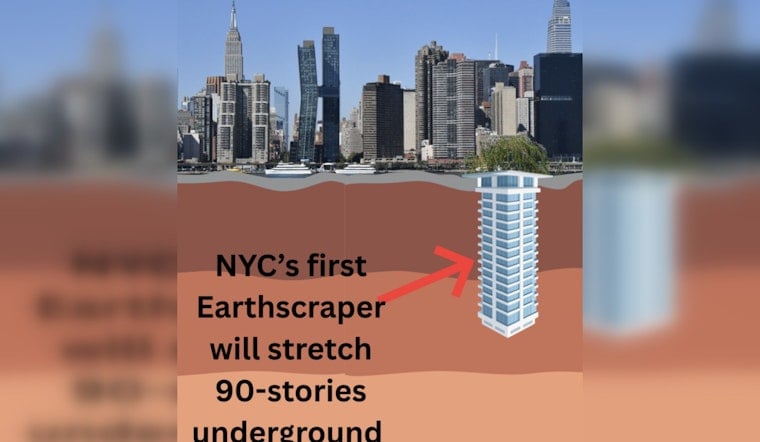
The New York City Department of Buildings says it has signed off on plans for what it is calling the city’s first "earthscraper" - a 90-story building dug below street level that is pitched as a way to add housing without crowding the skyline.
We’re leaving no stone unturned in tackling the city's housing crisis! Today DOB approved plans for NYC’s 1st underground skyscraper, a 90-story building constructed below street level to protect skyline views. Keep your eyes peeled for more “earthscrapers” across every borough https://x.com/i/status/2039324410734166176
- Department of Buildings (@NYC_Buildings) April 1, 2026
In a post on X, the agency said it had "approved plans for NYC’s 1st underground skyscraper" and described the project as a 90-story subterranean tower designed to "protect skyline views," according to the Department of Buildings.
What the City Announced
The social media announcement came with a punchy line - "We’re leaving no stone unturned in tackling the city's housing crisis" - but not a lot of fine print. There was no mention of where the tower would go, who is developing it or when construction might start.
Key nuts-and-bolts information such as engineering drawings, contractor information and a permit schedule was also missing from the post, which means any real-world timeline for shovels in the ground is still very much to be determined.
Where the Idea Comes From
The earthscraper concept has been floating around architectural circles for years as a way to boost density while keeping surface-level views and historic streetscapes intact. One of the most famous examples on paper is the Mexico City "Earthscraper" concept from BNKR Arquitectura, a proposal that burrows down instead of building up and that was widely covered in the design press, as noted by WIRED.
That earlier proposal helped cement the idea that, at least in theory, cities could chase growth by digging deeper rather than reaching higher.
Underground Precedents
While a 90-story fully subterranean tower would be new territory for New York, there are real-world projects that lean heavily below grade. The InterContinental Shanghai Wonderland hotel was built into an abandoned quarry, with many of its floors below the surrounding ground level. It opened in 2018 and is often cited as a large-scale proof of concept for ambitious underground construction, according to ABC News.
Engineering And Logistics Questions
Digging deep for a megastructure is not just a matter of more shovels. Large subterranean buildings face a different set of technical headaches than conventional towers: groundwater control, waterproofing, mechanical ventilation, access to daylight and safe evacuation routes all need careful, site-specific engineering and backup systems.
An international review of underground-city proposals highlights those tradeoffs and the need for rigorous planning for water, air and energy systems, according to an academic review.
Then there is the basic problem of dirt. A project of this scale would require massive excavation and removal of soil and rock in some of the most crowded neighborhoods on earth. Prior coverage of earthscraper concepts has flagged logistics, construction cost and neighborhood disruption as major obstacles to any city-scale rollout, as New Atlas has reported.
Regulatory Hurdles Ahead
Even if the Department of Buildings has accepted plans at the filing level, that is only one piece of New York’s development puzzle. Major projects typically move through environmental review and land use processes before any full-scale construction can begin.
Under the city’s environmental review rules, the CEQR process and the Uniform Land Use Review Procedure can trigger Environmental Impact Statements, community board hearings and votes by the City Planning Commission and the City Council, as outlined in the city’s CEQR Technical Manual.
The Department of Buildings itself oversees plan examinations and building permits, but permit approval is only one step in a long entitlement and construction chain. The agency’s online system, DOB NOW, spells out the filing and permitting track that developers must follow before work can legally start. Guidance on that process is available on the Department of Buildings.
What Comes Next
The viral post teased more "earthscrapers" across the boroughs, but without a timetable or even a single project address, the city is still at the concept stage for this kind of development.
Before any 90-story underground tower becomes more than a headline, New Yorkers can expect a long stretch of filings, environmental studies, community meetings and negotiations. For now, the earthscraper exists as a bold idea with a long list of engineering, regulatory and neighborhood hurdles standing between it and the bedrock.


