

























































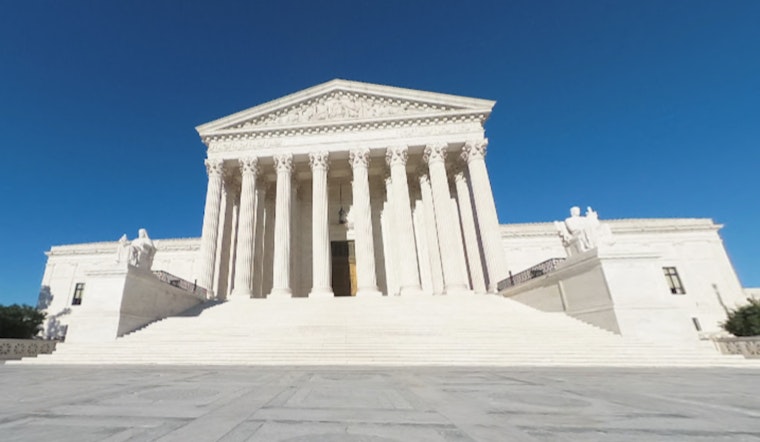
The U.S. Supreme Court is stepping into a high-stakes fight in Washington today, hearing arguments over whether the Federal Communications Commission can hit major wireless carriers with nearly $200 million in forfeiture orders without giving them a jury trial first. At issue are agency penalties tied to the alleged sale and mishandling of customers' location data.
According to the Supreme Court docket, the justices have consolidated the AT&T and Verizon appeals as Nos. 25-406 and 25-567 and set oral argument for April 21, 2026. The docket shows a single hour allotted for argument and multiple amici filings lining up on both sides.
The dispute stems from forfeiture orders the FCC issued in April 2024 that together totaled nearly $200 million for alleged unlawful sharing of device-location data with third-party aggregators. The FCC lists the final penalties as roughly $80 million for T-Mobile, $12 million for Sprint, $57 million for AT&T and about $47 million for Verizon.
The carriers headed to court, and the appeals courts did not agree with each other. The Second Circuit upheld the Verizon forfeiture, while the Fifth Circuit threw out the AT&T order, prompting the Supreme Court to step in, as reported by Reuters. The split turns on whether the agency's in-house assessment process crosses the line under the Seventh Amendment.
What the justices will decide
The core question for the justices is whether an FCC forfeiture order is a binding determination that itself triggers the right to a jury trial, or a nonbinding administrative finding that must later be enforced in federal court, where a defendant would receive a de novo jury trial. In a brief filed with the court, the federal parties argued that an FCC order does not by itself obligate payment and that the availability of a jury trial in a subsequent Department of Justice enforcement suit satisfies the Seventh Amendment; see the filing on the Supreme Court docket for details.
The argument unfolds against the backdrop of the Supreme Court’s 2024 ruling in Justia coverage of SEC v. Jarkesy, which limited agencies' use of in-house proceedings to impose civil penalties and has quickly become a touchstone for challenges like this one.
Legal stakes for privacy and enforcement
If the court sides with AT&T and Verizon, agencies that depend on in-house forfeiture orders could be pushed to bring more enforcement actions directly in federal court, slowing cases and shifting the balance between speedy regulatory action and defendants' jury-trial rights. Supporters of the FCC's approach, including former Commission chairs and consumer-privacy groups, warn that curbing agency forfeiture authority could blunt regulators' ability to respond to data-privacy harms; their position appears in a filing on the Supreme Court docket and in coverage noting consumer advocates' briefs.
Carriers counter that the FCC’s practice inflicts immediate reputational and commercial damage and that the possibility of a later jury trial in a separate recovery suit does not fix the constitutional problem, an argument summarized in previews of the case by SCOTUSblog.
The oral argument is scheduled for today, April 21, and observers say the decision could reshape how federal agencies across the government enforce civil penalties. Analysts expect a definitive ruling before the Court’s term ends, with implications for both consumer privacy enforcement and agency power going forward; follow-up briefs and the argument transcript are expected to clarify which lines the justices are most likely to draw.


