

























































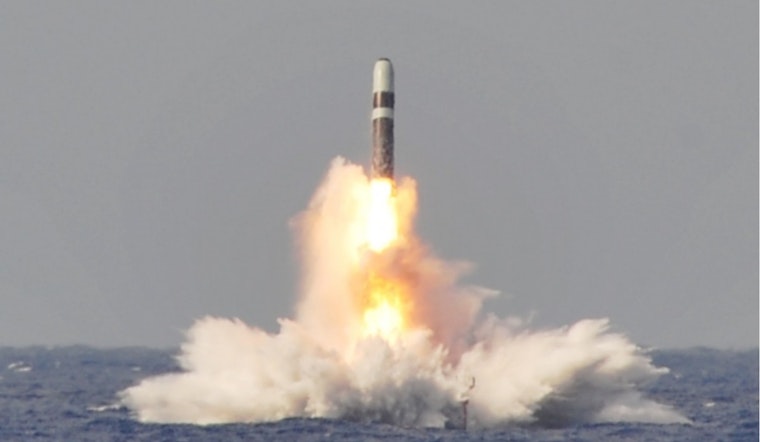
Denver’s defense sector just scored a massive payday, with Lockheed Martin Space landing a Pentagon contract worth roughly $850 million to keep the Navy’s Trident II (D5) submarine-launched ballistic missile in fighting shape. More than half of the work under this latest modification will run through the company’s Denver-area operations in Jefferson County, putting local engineers at the center of one of the highest-profile missile programs in the U.S. arsenal as the Navy shifts to its Columbia-class submarines.
What the Pentagon award says
According to the Department of Defense, the deal is a cost-plus-incentive-fee modification valued at $850,410,935 to an existing contract for the Trident II (D5) Life Extension 2 advanced design and development program. The notice lists Denver as the primary worksite, accounting for about 55.20% of the effort, with Strategic Systems Programs in Washington, D.C., identified as the contracting activity. It is funded with fiscal 2026 Navy weapons procurement dollars and carries an expected completion date of Sept. 30, 2030. The award was made on a sole-source basis under 10 U.S.C. 2304(a)(1), a reminder that when it comes to this missile, the Pentagon is sticking with the team it knows.
Local impact in Jefferson County
The Denver Business Journal reports that the majority of the work will move through Lockheed’s Jefferson County facilities, a clear boost for the company’s Colorado workforce. Local engineering teams, systems integrators, and specialty suppliers that support guidance, propulsion, and testing are expected to feel the uptick as the D5 design push accelerates. The contract underscores Denver’s growing role in ship-launched strategic systems work and quietly raises the city’s profile inside the Pentagon’s long-term planning conversations.
Program background
The Trident II D5 Life Extension 2 effort aims to keep the Navy’s sea-based strategic deterrent both modern and reliable as submarines and supporting technologies evolve. In an earlier release about related work, Lockheed Martin outlined phases of the D5 life-extension work and said the upgrades are intended to “maintain the nation’s sea-based strategic deterrence.” The company noted that the program spans multiple U.S. sites along with several years of engineering and production activity, so Denver is one key piece of a much larger, long-haul puzzle.
What to watch next
The Pentagon notice ties fiscal 2026 weapons procurement dollars directly to this modification, which typically signals a steady stream of funding over the life of the work. How quickly the money turns into local action will show up in hiring announcements, task orders and subcontract awards in the coming months, as Denver-area teams shift into more detailed design and development roles. For now, the award firmly locks Denver into a central position on a program that sits at the core of the Navy’s nuclear deterrent posture.



