

























































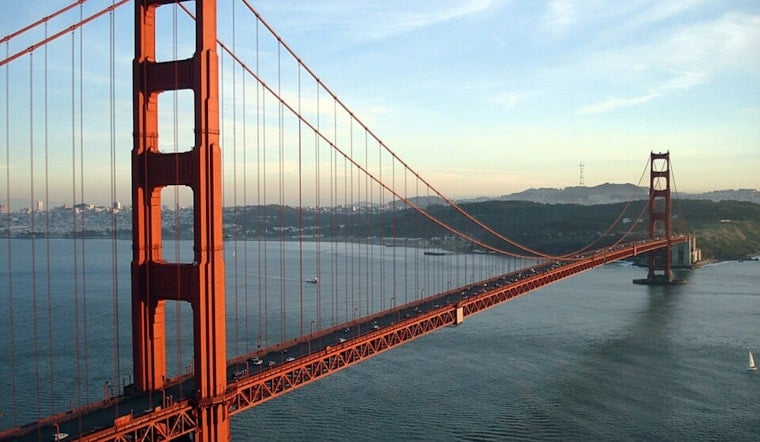
Bay Area drivers bracing for a Francis Scott Key Bridge-style catastrophe under the Golden Gate Bridge can relax a bit. A fresh engineering review, commissioned this spring after the Baltimore collapse, concludes that a full bridge failure from a wayward ship is highly unlikely.
What the engineers found
The study ran a series of worst-case scenarios: large ships veering off course, hitting critical supports at speed, and delivering maximum impact. Even under those conditions, engineers found multiple layers of protection that make a collapse extremely improbable.
The report pegs the annual chance of a collapse from a ship strike at roughly 1 in 40,000 to 1 in 70,000. That estimate does not even count operational safeguards such as tug escorts and vessel-traffic control that further reduce the odds, according to the San Francisco Chronicle.
District's own risk calculation
The Golden Gate Bridge Highway and Transportation District brought in a consultant to run an AASHTO Method II probabilistic vessel-collision risk assessment, which wrapped up in February 2026. Using recent vessel traffic data, the consultant calculated a return period for collapse that beats the AASHTO minimum standard of 10,000 years by about four times.
In plain language, that keeps the annual risk well below the 0.0001 threshold used in the guidelines. Those figures are laid out in the district's board packet from the review, available through the Golden Gate Bridge Highway and Transportation District.
Built-in protections
The bridge is not relying on luck alone. The south tower sits inside a massive reinforced concrete fender system. The report describes a protective shell about 27 to 28 feet thick at the base that can take lateral loads on the order of 50,000 kips.
In many of the modeled crashes, engineers found the ship itself would crumple and soak up much of the impact energy before the bridge tower took serious damage. On top of that, only about 25 vessels large enough to pose a structural threat pass under the bridge's 4,200-foot span on a typical day, according to the San Francisco Chronicle.
Why the north tower is different
The north tower, on the Marin side, does not have the same thick concrete ring wrapped around its base. Instead, geography does some of the work. The district notes that the relatively shallow water around the north pier would likely cause a fully loaded ship to run aground before it could reach the tower.
That combination of structural defenses, seabed conditions, and predictable ship traffic patterns means a very specific and unlikely chain of failures would have to occur for the bridge to collapse. The district lays out that reasoning in its statement on the federal safety recommendations, available from the Golden Gate Bridge Highway and Transportation District.
National context: a broader review of bridges
The scrutiny on the Golden Gate is part of a bigger national rethink of how vulnerable major bridges are to ship strikes. As part of its investigation into the Key Bridge disaster, the National Transportation Safety Board in March 2025 urged 30 bridge owners to evaluate 68 bridges in 19 states for collapse risk tied to vessel impacts.
The NTSB spelled out those recommendations in a public notice, and follow-up reporting has detailed how Caltrans and regional toll agencies have begun or commissioned similar checks on Bay Area spans, as covered by the Los Angeles Times.
Bottom line and what’s next
District engineers and outside experts are not sounding any immediate alarms. Instead, they say the new risk study will help shape long term decisions on fender systems, navigation rules, and any targeted upgrades that could further harden the bridge against wayward ships.
All of this is unfolding while the Golden Gate Bridge is already in the middle of a multi-year seismic retrofit program that will pour hundreds of millions of dollars into strengthening towers and spans. A detailed breakdown of that work, including costs and schedule, is available in industry coverage from Engineering News-Record.





