

























































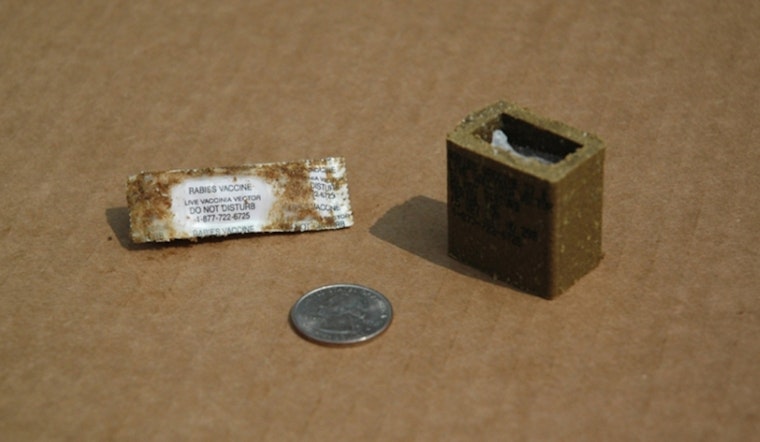
Next week, parts of East Tennessee will see low-flying planes and helicopters crisscrossing the sky as the U.S. Department of Agriculture rolls out a large rabies prevention push. Crews will scatter edible rabies vaccine baits to help shield people and pets from raccoon rabies as part of a broader multi-state effort.
The baits are fish-scented packets about the size of a matchbox, and they will be spread across rural and suburban neighborhoods. Residents in the targeted counties can expect unusual aircraft overhead and small packets turning up in yards and along wooded edges. Federal officials say the goal is to create a vaccinated buffer zone that keeps raccoon rabies from creeping west into new communities.
According to WBIR, the larger operation will put out about 1.7 million oral rabies vaccine baits across east Tennessee, western North Carolina, southwest Virginia, and north Georgia. More than 300,000 of those packets are slated for Tennessee alone. WBIR reports that fixed-wing planes will handle rural airdrops April 8–18, while helicopter drops are planned for April 13–19 in urban and suburban areas, including Bristol, Chattanooga, Elizabethton, Erwin, Johnson City, and Mountain City.
How the drops work
USDA's Animal and Plant Health Inspection Service says each bait contains a small vaccine pouch tucked inside a fishmeal coating that attracts raccoons and other mesocarnivores. When an animal chews the bait, it punctures the internal packet, and the vaccine triggers an immune response. As outlined by USDA APHIS, planes are typically used to cover broad rural stretches, while helicopters, vehicles, and hand placement are used in developed areas to make sure the baits end up where target animals are most likely to find them.
Where in Tennessee
The Tennessee Department of Health, which has worked with USDA on oral rabies baiting for years, notes that east Tennessee counties remain the focus of these targeted vaccine drops. As detailed by the Tennessee Department of Health, past and planned efforts include counties such as Bradley, Carter, Cocke, Greene, Hamilton, Johnson, Marion, McMinn, Monroe, Polk, Sullivan, Unicoi, and Washington.
Officials are asking residents to leave intact baits where they are, keep kids and pets away from them, and not try to pull a bait out of an animal’s mouth. The North Carolina Department of Health and Human Services adds that if a bait needs to be moved out of a play area, people should wear gloves, and if a packet breaks and gets on skin, wash thoroughly with soap and water. The agency also recommends calling the hotline number printed on the bait for more detailed guidance, according to NCDHHS.
USDA officials say oral rabies vaccine baiting is a long-used tool in the National Rabies Management Program and has been deployed for years in Tennessee and neighboring states to slow the westward spread of the raccoon rabies variant. The USDA APHIS program notes that oral rabies vaccination campaigns have been in place since the 1990s and that targeted baiting remains a key strategy to reduce spillover infections in pets and people.
During the roughly two-week window, residents should expect extra aircraft activity and some vehicle-based crews. Operations will be staged from regional airports, with field teams on the ground in certain cities. WBIR reports that ground teams will be driving bait routes in Chattanooga around the same time, and that the work is being coordinated with local authorities to answer questions and limit disruption.
Pet owners are urged to keep their animals’ rabies shots up to date and to reach out to their veterinarian or the Tennessee Department of Health if they need local guidance. USDA Wildlife Services also maintains a rabies information line at 1-866-487-3297. For photos of the bait packets and more details on what to do if you find one, the Tennessee Department of Health has additional guidance available.





