

























































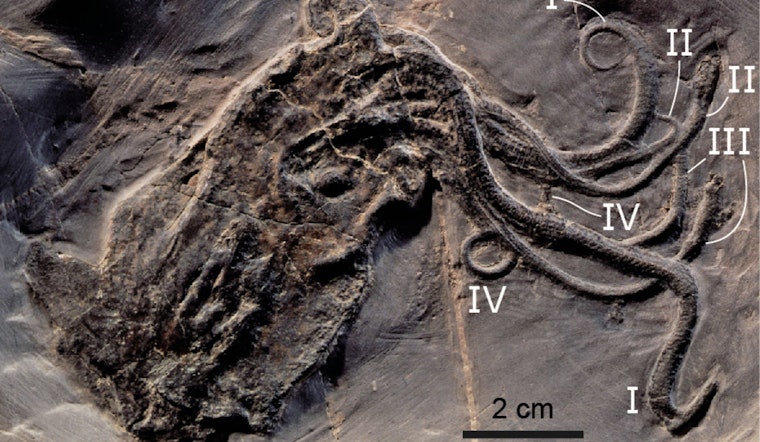
For years, a 300-million-year-old fossil in Chicago was celebrated as the world’s oldest octopus. Now, after a fresh round of high-resolution scans, that celebrity cephalopod has been kicked out of the octopus club and reclassified as a nautiloid instead. The specimen, Pohlsepia mazonensis, part of the Field Museum's collection in Chicago, will no longer serve as evidence that octopuses roamed the Paleozoic. The shakeup tweaks a key piece of cephalopod history and sends museum and record-keeping teams back to the scanners.
Scans Uncover Hidden Teeth
Using synchrotron imaging, researchers peered inside the iron-rich Mazon Creek concretion that holds the fossil and spotted a radula, the ribbon of tiny teeth found in many mollusks, preserved in the rock. Each tooth row carried 11 teeth, the team reports, a count that does not fit octopuses, which have seven or nine, and instead matches the nautiloid Paleocadmus pohli known from the same deposit. The study, published April 8 in Proceedings of the Royal Society B, and its CT datasets are documented in a press release and repository, according to EurekAlert!.
Field Museum Reaction
The Pohlsepia specimen has been in the Field Museum since it was donated by collector James Pohl, and curators say the reclassification is both surprising and scientifically useful. Paul Mayer, manager of the museum's fossil invertebrates, told The Associated Press he was "a little surprised" but noted that researchers had questioned the octopus identification for years. Lead author Thomas Clements said the new reading gives the museum "the oldest soft tissue nautilus in the world," a specimen that can now be studied with modern tools to learn more about early cephalopod biology.
Why This Rewrites the Timeline
For decades, Pohlsepia served as a calibration point that pushed octopus origins deep into the Paleozoic, creating a puzzling gap between molecular clocks and other fossils. With Pohlsepia reinterpreted as a nautiloid, that mismatch largely disappears and the likely appearance of true octopuses shifts toward the Mesozoic, a realignment explored in coverage by Science News. The authors suggest that decomposition before burial stripped away a shell and produced a blob-like impression that early researchers read as an octopus.
Records, Reexaminations and What's Next
Guinness World Records said it will "rest" the original earliest-octopus listing while it reviews the new evidence, acknowledging the reversal reported by news outlets. The team has posted elemental maps and CT data so other scientists can test the interpretation, and the repository entry lists the specimen as PE51727 in the Field Museum collection. Museum staff say they will continue to make material available for new imaging studies, which they hope will reveal additional surprises about the Mazon Creek fauna, as outlined in the dataset on Dryad.
What It Means Locally
The turnabout is a reminder that Chicago's museum collections remain central to global science and that new technologies can upend long-held assumptions. For now, Pohlsepia's demotion from octopus royalty leaves the Field Museum with a fresh scientific headline and a rare example of preserved nautiloid soft tissue for researchers to study, as summarized by Smithsonian Magazine.





