

























































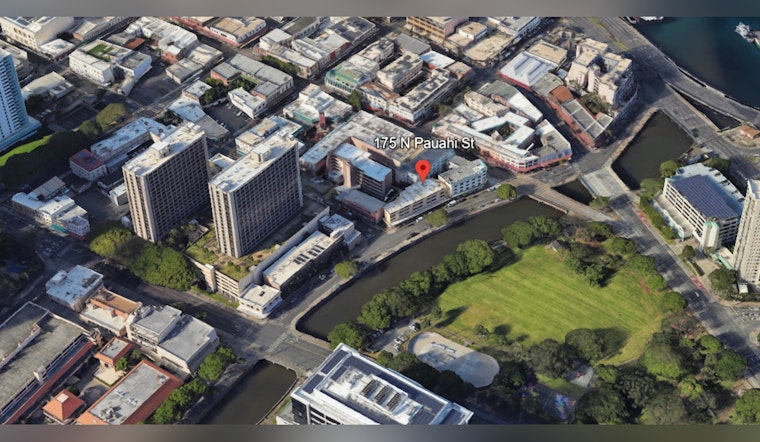
Honolulu just bought itself a big foothold in Chinatown’s housing future, closing on an aging apartment building at 175 N. Pauahi Street as part of a broader push to add more affordable homes in the urban core.
The deal, finalized April 1, cost the City and County of Honolulu about $4.52 million. The three-story walk-up holds 42 residential units, but only four are currently occupied, according to city officials. The plan, they say, is to first stabilize the property, get the existing units back into use and then take a harder look at whether the site should be renovated or potentially used for other community-focused projects.
As reported by Hawaii News Now, the roughly 8,231-square-foot parcel sits at the corner of N. Pauahi and River streets on the edge of Chinatown and was acquired by the city’s Department of Housing and Land Management. The outlet notes that just four of the building’s 42 units are occupied and that, before any major overhaul, the city will focus on basic site stabilization and property management so it can move units back onto the market as quickly as possible.
“This acquisition is part of our long-term strategy to make better use of strategically located properties to address Honolulu’s housing needs,” Mayor Rick Blangiardi said, according to Hawaii News Now. Department of Housing and Land Management director Kevin Auger added that the buy helps consolidate city ownership on the block and opens the door for a coordinated master plan that could blend housing, services and active street-level uses.
How This Fits Into Honolulu’s Housing Game Plan
The purchase builds on the recent creation of the Department of Housing and Land Management, which was set up to pull scattered housing functions under one roof and speed up the use of city-owned land for homes. According to the department’s 2025–2028 Strategic Housing Plan, priorities include pushing transit-oriented development and bringing underused urban parcels back to life. That playbook helps explain why the city is so interested in knitting together properties in and around Chinatown.
In practical terms, the Pauahi Street building is another puzzle piece in a bigger map: city-owned sites clustered near transit, services and small businesses that can eventually be planned together instead of one by one.
What This Means For Tenants And The Block
In the short term, officials say the focus will be on basics: securing and stabilizing the property, improving management and leasing out existing units where possible while longer-term options are studied. Any significant redevelopment would still need to go through formal planning and permitting, plus community engagement, before shovels hit the ground.
On the table are possibilities such as a renovated version of the current building, a new affordable housing development, or a mixed-use project that layers in ground-floor commercial or community space intended to serve Chinatown residents and nearby small businesses.
The Pauahi Street move follows earlier efforts by the city to scoop up key urban parcels for housing and transit-oriented projects, including larger acquisitions such as the Iwilei Center that city leaders have pointed to as part of a strategy to connect multiple sites into larger, coordinated developments, as reported by the Honolulu Star-Advertiser. Officials say buys like this give Honolulu more flexibility to design projects that mix housing, services and street-level commercial space into one broader neighborhood vision, rather than treating each building as a one-off.





