

























































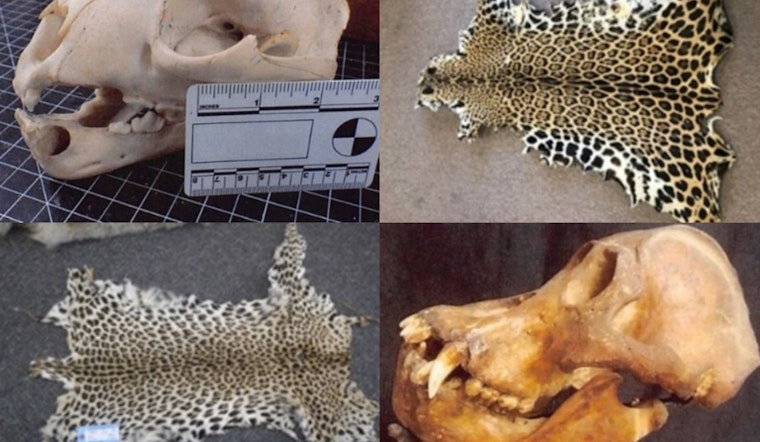
A Mattapan psychiatrist who built a shadow business trading in skulls and skins from protected wildlife has been ordered to report to federal prison in mid-May. Adam Bied, 40, was sentenced in Boston to an eight-month federal term, to be followed by two years of supervised release. He was also hit with a $75,000 fine and agreed to give up more than 100 wildlife specimens that agents seized in a 2021 law-enforcement sweep.
According to a press release from the U.S. Attorney’s Office for the District of Massachusetts, Bied pleaded guilty in January to two counts of conspiracy to smuggle goods into the United States and two counts of violating the Lacey Act. U.S. Senior District Court Judge F. Dennis Saylor IV handed down the sentence on April 2, 2026, and federal prosecutors said the $75,000 fine will go toward wildlife-enforcement efforts.
As detailed by The Boston Globe, Bied lives in Reading and ran a private psychiatry and neurology practice in Mattapan. In court, he pushed for probation and painted himself as a collector who got carried away with a hobby. Prosecutors countered that description and branded him a “prolific trafficker” who bought, sold and traded body parts from some of the planet’s most endangered animals.
How Investigators Say He Operated
Court filings and the government’s sentencing memorandum describe a much more calculated operation. Investigators say Bied placed orders with suppliers in Cameroon and Indonesia, traded hundreds of pages of WhatsApp messages, and even offered to send ammunition to a poacher in exchange for “rare” skulls. In one exchange, according to filings from the U.S. Attorney’s Office for the District of Massachusetts, he instructed a co-conspirator to “stop sending me skulls with holes.” He later sold two illegally imported leopard skulls to an undercover U.S. Fish and Wildlife Service agent. In July 2021, agents seized more than 100 specimens from his home, a storage unit and a vehicle.
Seized Trove And Conservation Stakes
Officials say the stash included orangutan and tiger skulls, leopard and jaguar skins, a narwhal tusk and dozens of other pieces from species protected under CITES and the Endangered Species Act. The civil-forfeiture complaint and a detailed list of what was taken are outlined in reporting by Boston.com.
Officials Respond
“Trafficking in the remains of endangered and protected animals is not a collector’s hobby — it is a crime that fuels the exploitation of vulnerable species around the world,” U.S. Attorney Leah B. Foley said in a statement quoted by The Boston Globe. U.S. Fish and Wildlife Service Assistant Director Doug Ault said shutting down this kind of black-market trade remains a high priority because it pushes critically endangered animals closer to extinction.
Penalties And Next Steps
The crimes Bied admitted to carry far steeper theoretical penalties than what he received. Felony violations of the Lacey Act can bring up to five years in prison and significant fines, although federal judges sentence defendants case by case under the guidelines. For background on the Lacey Act and related penalties, see the Congressional Research Service. Prosecutors say they will also seek forfeiture of the seized items as part of the ongoing case, according to that summary.
The sentence caps the local end of a trafficking investigation that reached from a Reading home and a Mattapan office to forests in Indonesia and hunting parties in Cameroon. It also shows how U.S. authorities are increasingly working their way up the supply chain to target the buyers and collectors who keep the trade alive. For now, the next chapter will play out on paper, as the court finalizes forfeiture orders and the logistics of when and how Bied reports to prison.




