

























































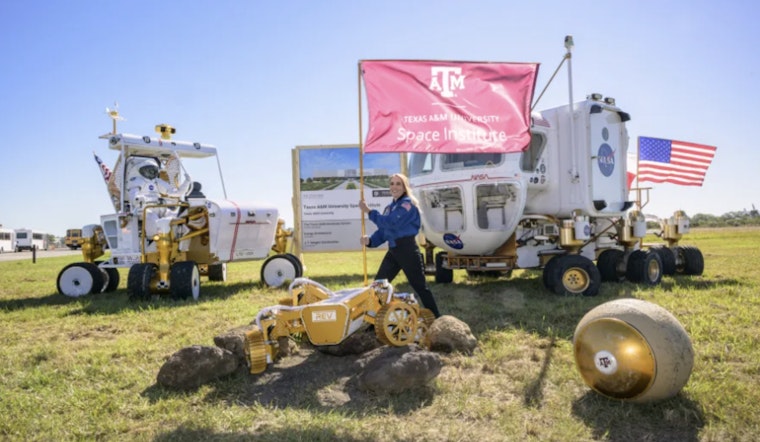
Texas A&M University’s giant Space Institute at NASA’s Exploration Park has hit a major milestone, with the steel structure now officially topped out for the roughly 400,000-square-foot research campus. With the skeleton in place, crews are pivoting to interior buildout and to shaping the facility’s sprawling simulated lunar and Martian surfaces. The complex sits just outside the Johnson Space Center perimeter and is slated to house labs, training garages and a public auditorium aimed at tying university research more closely to industry partners.
As reported by ConnectCRE, Vaughn Construction marked the topping-out and has shifted into work on roughly 234,000 square feet of lunar and Martian “scapes” inside the building. Those two engineered terrains are expected to cover an area about the size of two football fields and make up much of the project’s specialized testing footprint.
According to Texas A&M University, the Space Institute will feature research garages, classrooms, instrument laboratories and a public auditorium. The project is backed by about $200 million in state funding approved by the Texas Legislature in 2023. The university notes that the test scapes and neighboring lab spaces will be available to commercial partners, government agencies and other universities for testing, training and workforce development across the region.
NASA marked a ceremonial groundbreaking for the Institute on Nov. 15, 2024, identifying the project as the first major tenant inside the agency’s new Exploration Park. Industry coverage and project databases list Vaughn Construction as the general contractor and Energy Architecture as the design partner on the 32-acre site, per Tradeline.
The build is moving quickly. Local reporting and project briefs have pegged substantial completion in the fall of 2026, and the Houston Chronicle, for example, notes construction was slated to wrap by October 2026. Several tenants have already locked in space inside the Institute, and ConnectCRE reports that some incoming occupants have received grants from the Texas Space Commission to help with relocations.
Why This Matters For Houston
Exploration Park is designed to bring NASA talent, university research and private industry into closer orbit with one another, creating a local ecosystem for aerospace R&D and commercialization, according to reporting from Houston.org. Backers say the Space Institute’s mix of test scapes, clean labs and training programs could help anchor new technical jobs in the Clear Lake and Bay Area economies while giving companies a place to prototype hardware just down the road from Mission Control.
What Comes Next
With the outer shell complete, construction teams will now zero in on fitting out laboratories, finishing the moonscape and marscape surfaces, and building out dozens of 2,000-square-foot garage bays planned for industry partners. Texas A&M University frames the Institute as a shared regional resource for testing, training and workforce development as it prepares the facility for partner occupancy later this year.




