

























































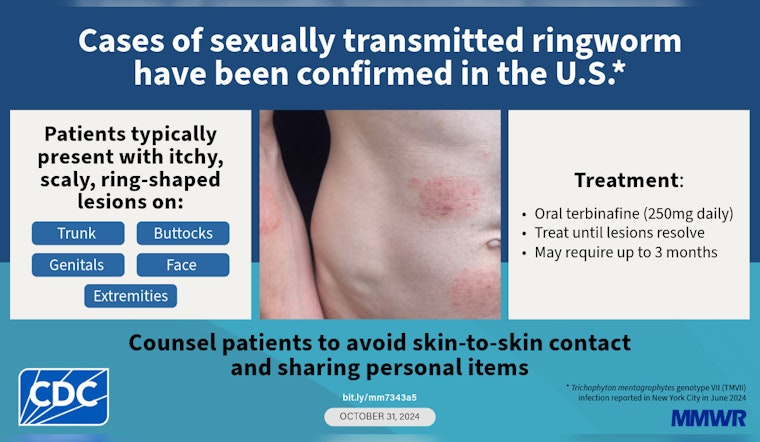
A newly identified sexually transmitted fungal infection has officially shown up in King County, and health officials are not taking it lightly. The infection, known as TMVII, is a strain of Trichophyton mentagrophytes and typically appears as itchy, scaly, ring-shaped rashes in the groin or genital area that can be stubbornly slow to clear. With one local case now confirmed, officials warn that additional infections may be circulating under the radar and are urging both clinicians and anyone with suspicious symptoms to get checked out instead of relying on drugstore creams.
County advisory
Public Health - Seattle & King County issued a clinician health advisory on March 30, 2026, confirming one Washington case and calling on providers to test and treat aggressively, according to Public Health - Seattle & King County. The advisory notes that PCR testing and sequencing to confirm TMVII are available through the University of Washington Microbiology Laboratory and that suspected patients can be evaluated at the county Sexual Health Clinic at Harborview.
Officials caution that standard over-the-counter topical antifungal creams often do not do the job for TMVII. Many infections require prescription oral antifungal therapy for an extended course, so clinicians are being asked to keep a low threshold for testing and treatment when they see persistent genital or groin rashes.
Where it has been found
TMVII first popped up in the United States in 2024, when New York City investigators reported several cases of genital tinea tied to sexual transmission, according to the CDC. Since then, the Minnesota Department of Health has identified a cluster of roughly 30 confirmed or suspected cases in the Twin Cities metro, the state agency reported, which currently makes it the largest known U.S. cluster.
Symptoms and diagnosis
Clinically, TMVII tends to show up as very itchy, ring-shaped, scaly plaques on the genitals, buttocks, face, trunk, or extremities. It can easily be mistaken for eczema or psoriasis, according to a case report in JAMA Dermatology. That overlap in appearance is one reason health officials are worried the infection could be missed or misdiagnosed.
Definitive identification usually requires fungal culture with molecular sequencing or PCR testing. Clinicians are being urged to collect skin scrapings and consider referral when rashes are persistent, inflamed, spreading, or not responding to topical treatment.
Treatment and prevention
For the general public, the message is straightforward: if you notice a persistent, itchy, ring-shaped rash in the groin or genital area that does not clear with over-the-counter creams, avoid skin-to-skin contact, including sex, and get evaluated by a medical professional.
Clinicians, meanwhile, are being advised to start empiric oral terbinafine at 250 milligrams daily for suspected TMVII without waiting for lab confirmation and to continue treatment until two weeks after symptom resolution. That typically means a course of six to eight weeks and sometimes as long as twelve weeks, according to Public Health - Seattle & King County.
Patients are also urged to avoid sharing razors, towels, bedding, or sex toys and to notify any partners who might be having similar symptoms so they can get checked and treated if needed.
What experts say
Dr. Matthew Golden, who works with the county sexual-health program, told FOX 13 Seattle that TMVII is not considered life threatening but generally requires specific medical treatment to fully clear. In other words, it is not cause for panic, but it is not something to shrug off either.
A national report in Emerging Infectious Diseases found that many clinicians across the country are still unfamiliar with TMVII. The report concluded that increasing clinician awareness and strengthening laboratory capacity will be critical for catching cases early and preventing wider spread.
For clinical images, specimen-collection guidance, and more detailed reading, health care providers can consult the Minnesota Department of Health's TMVII guidance along with the JAMA Dermatology report referenced above. Local clinicians can also contact the Public Health - Seattle & King County Sexual Health Clinic for consultation and testing referrals.


