

























































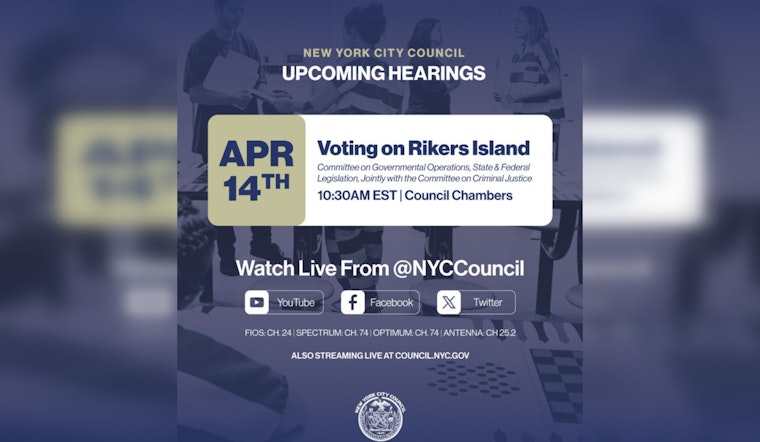
Ballot access at Rikers Island is heading under the City Hall microscope tomorrow morning, as New York City Council members dig into how jailed New Yorkers actually manage to vote.
The Committee on Governmental Operations, State & Federal Legislation will join the Committee on Criminal Justice for an oversight hearing at 10:30 a.m. in the Council Chambers at City Hall. The session will review how the Department of Correction and the Board of Elections handle voter registration, absentee ballots and the process for curing defective ballots for people held in city jails. Council members are also set to weigh two proposed local laws that would formalize ballot-curing procedures and require annual reporting on voter registration and absentee ballots in city facilities.
How to watch
The Council announced the hearing in a post on X, saying the session will be livestreamed on the Council’s website and across its social channels. Cable and over-the-air viewers can tune in on Fios ch. 24, Spectrum and Optimum ch. 74, and antenna ch. 25.2. According to the New York City Council, the stream will also be available on YouTube, Facebook and the Council’s site.
What’s on the agenda
The committees’ printed agendas list Int. 786-2026, a local law that would require the Department of Correction to work with the Board of Elections to deliver cure notices and help jailed voters correct curable defects on early-mail and absentee ballots. Also on deck is Int. 797-2026, which would require an annual report on voter registration activity and absentee ballots distributed at city jails. Both bills have multiple Council sponsors and are scheduled for committee consideration at the hearing, per Int. 786-2026 and Int. 797-2026.
Why it matters
Access to the ballot for people detained in jails has long been uneven. The League of Women Voters of New York State’s report on voting in jails highlights a Rikers program but warns that practices vary widely and that many facilities lack consistent voter outreach or resources, according to the League of Women Voters of New York State.
Research from the Prison Policy Initiative documents familiar obstacles, including jail-mail delays, confusion over eligibility and rapid population churn that regularly keeps eligible jailed voters from casting ballots. Advocates say the local measures are aimed at closing those gaps, and the issues the bills target are the kind of practical problems that can create de facto disenfranchisement even where the right to vote on paper remains intact, according to the Prison Policy Initiative.
State context and next steps
At the state level, lawmakers have floated proposals such as S440, which would authorize polling places at correctional facilities and require boards of elections to ensure detained eligible voters can register and cast ballots. That effort gives the city’s local work a broader legislative backdrop. The state proposal is detailed in New York State Senate bill S440.
If the Council committees advance the local measures, they would set reporting timelines and formal lines of collaboration between the Department of Correction and election officials. Advocates and elections administrators will be watching for specific commitments on privacy, language access and timely ballot delivery.
The hearing starts at 10:30 a.m. tomorrow in Council Chambers, with members of the public able to watch via the Council’s livestream and the channels noted by the Council. Committee materials and any post-hearing reports or testimony are expected to be posted to the Council’s legislative files after the session, which will show whether city agencies commit to the data-sharing and ballot-cure procedures the introduced bills would require.





