

























































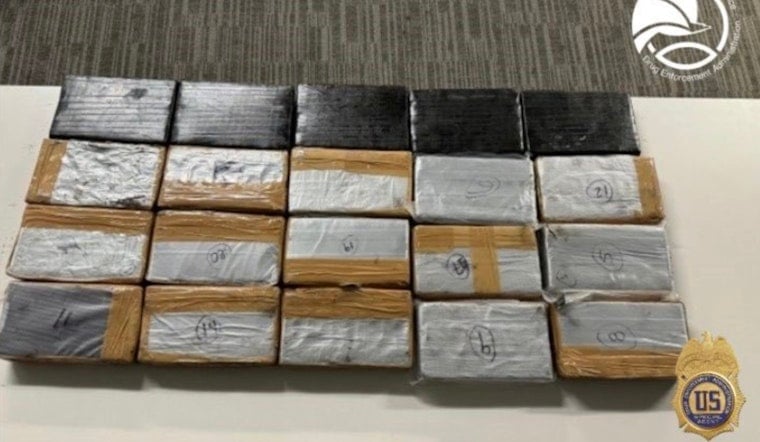
A 45-year-old Worcester, Massachusetts man has been sentenced to 14 years in New York state prison after a Manhattan jury convicted him of running nearly 45 pounds of cocaine down Interstate 95 toward New York City. Carlos Almonte Palmers was found guilty on June 26 following a two-week trial, and Manhattan Supreme Court Justice Sara Litman handed down the sentence this week, adding five years of post-release supervision on top of the prison term.
The case was prosecuted by the Office of the Special Narcotics Prosecutor for the City of New York, the agency that has handled felony drug trafficking cases across the five boroughs since it was established by the state legislature in 1971, according to the DEANewYork announcement of the sentencing. Special Narcotics Prosecutor Bridget G. Brennan, who has led the office since 1998 according to Pace University, said the sentence reflects the devastating impact of high-level narcotics trafficking.
#DEANewYork Task Force Division Special Agent in Charge Christopher Roberts announces Interstate Cocaine Trafficker Sentenced to 14 Years Following Conviction at Trial. Great work @snpnyc! @DEAHQ @TheJusticeDept @NYPDnews @nyspolice @PostalInspector https://t.co/JPkZyJyWi6 pic.twitter.com/3kBqj8dkwx
— DEANewYork (@DEANEWYORKDiv) August 7, 2026
Tracking a Jeep From Massachusetts to a New Jersey Truck Stop
Investigators with the DEA New York Task Force Division's Group T-41, a unit that includes agents and officers from the DEA New York Division, NYPD, and New York State Police, began surveillance on a Jeep Grand Cherokee registered to Palmers in Massachusetts. On March 13, 2024, at around 7 p.m., the task force picked up the vehicle traveling southbound on I-95 near the New York state-Connecticut border, having started the trip near Lawrence, Massachusetts.
The Jeep crossed into the Bronx and Manhattan, over the George Washington Bridge, and into New Jersey, where it pulled up beside a tractor trailer at the Alexander Hamilton Travel Plaza in Secaucus at roughly 7:50 p.m. That rest stop sits at Exit 18E on the New Jersey Turnpike, a corridor federal investigators have flagged as a frequent transfer point for bulk narcotics moving along the Northeast's interstate network, according to the Drug Enforcement Administration.
Duffel Bag of Cocaine Found on the Major Deegan
After the pickup, Palmers drove the Jeep back into New York, where agents and officers stopped the vehicle on the Major Deegan Expressway near the Cross County Parkway exit in Yonkers. Inside, investigators recovered a duffel bag containing rectangular objects that DEA laboratory analysis later confirmed were 20 kilograms, or nearly 45 pounds, of cocaine with a street value of more than $1 million.
Prosecutors say Palmers had made similar same-day trips from Massachusetts to the New York City area on several prior occasions before his arrest. He was arraigned in Manhattan Criminal Court on March 14, 2024, and ordered held without bail on top counts of first-degree and third-degree criminal possession of a controlled substance.
A Predicate Felon Facing a Mandatory Minimum
Because Palmers had previously served an eight-year sentence for a Bronx conviction on attempted criminal sale of a controlled substance in the first degree, he qualified as a predicate felon and faced a mandatory minimum of 12 years in prison. Under New York Penal Law § 70.71(3)(b)(i), a non-violent second felony drug offender convicted of a Class A-I felony faces a determinate sentence of 12 to 24 years, according to FindLaw. Palmers had also been deported from New York to the Dominican Republic in 2022, according to the seed announcement, before the March 2024 arrest that led to this case.
DEA New York Task Force Division Special Agent in Charge Christopher Roberts said the 14-year sentence sends a message to anyone using the nation's highways to move narcotics. “This 14-year prison sentence sends a clear message to those looking to use our nation's highways to traffic deadly narcotics into our communities, that your actions will have consequences,” Roberts said. “The seizure of nearly 45 pounds of cocaine prevented more than a million dollars' worth of poison from reaching neighborhoods throughout New York and the Northeast corridor. This outcome is the result of relentless investigative work and seamless coordination among our federal, state, and local partners.”
City Officials React to the Verdict
NYPD Commissioner Jessica S. Tisch said Palmers attempted to flood New York City with nearly 45 pounds of cocaine but that the interagency task force stopped him before it could hit the street. Roberts also credited the outcome to the joint effort among the DEA New York Task Force Division, the NYPD, and the New York State Police, while Brennan separately thanked Bronx District Attorney Darcel D. Clark and commended the same agencies along with the U.S. Postal Inspection Service New York Division, which assisted the multi-agency investigation.
City narcotics prosecutors have previously pointed to record levels of cocaine production in Colombia as a driver of the surging supply of bulk cocaine entering New York City markets, per the Office of the Special Narcotics Prosecutor. That supply pressure has coincided with grim public health numbers: CDC National Center for Health Statistics estimates cited by legal authorities in 2024 put New York City's 2023 drug overdose death toll at 3,156.
Part of a Broader Pattern of Highway Interdictions
The case fits a pattern of recent interstate cocaine busts funneling through New York's court system. Hoodline reported in February on a separate joint DEA and Special Narcotics Prosecutor operation that intercepted roughly 10 kilograms of cocaine from New York City's distribution pipeline. Late last year, Hoodline also covered the case of a Manhattan man sentenced to 151 months in prison after authorities intercepted him transporting 22 kilograms of cocaine along New York highway routes, following his earlier guilty plea in a case that had carried a possible sentence of 10 years to life.
Palmers was ultimately charged with a single count of first-degree criminal possession of a controlled substance, the top count that carried the mandatory sentencing enhancement. The Drug Enforcement Administration's New York Task Force Division and the Office of the Special Narcotics Prosecutor framed the case as part of a continued effort to intercept bulk narcotics before they reach street-level distribution in the city and across the broader Northeast corridor.




