

























































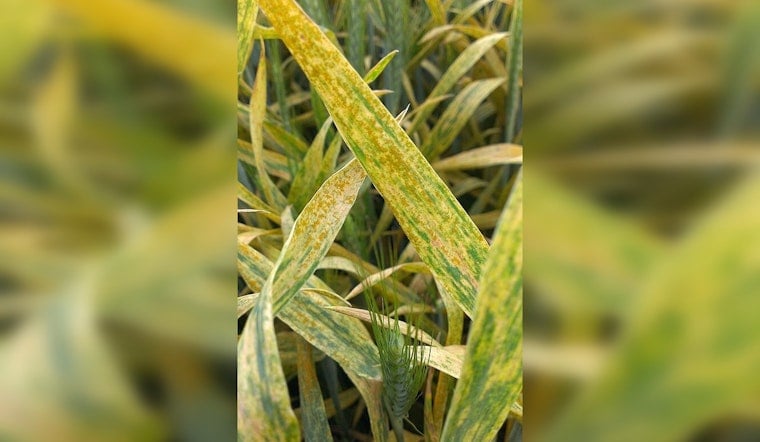
Wheat growers across the Pacific Northwest are staring down an unusually early, fast-moving outbreak of stripe rust, and the season is already looking like it could be rough for susceptible varieties. Plant pathologists tracking the disease say the fungus is active in experimental plots and some commercial fields, and a spell of warm, wet weather in the weeks ahead could turbocharge its spread.
Forecast puts 2026 in the upper range of severe epidemics
Forecast models from Dr. Xianming Chen peg 2026 in the upper range of a severe stripe-rust epidemic. On the most susceptible wheat varieties, the projections show potential yield losses of about 40–60%. For the commercially grown mix of varieties in the region, the same forecast estimates an average yield hit of roughly 8% if no fungicide is applied.
Where the rust is showing up
Field checks have already turned up infections in research nurseries and some commercial fields across eastern Washington and parts of Oregon and Idaho. Reports so far include sites near Lind, Walla Walla, Central Ferry, Mount Vernon, Pullman and Hermiston. Local grower groups and ag outlets have been amplifying Chen’s updates; the Washington Association of Wheat Growers has been sharing alerts, and Capital Press reported mid-April follow-up checks that found a Horse Heaven Hills field with heavy rust and stripe rust on goat grass along a field edge in Idaho.
What growers should do
Chen is urging growers to get out and scout, and to line up fungicide passes with other operations when it makes sense. For varieties rated 3–9 for stripe rust, he recommends applying a fungicide at the same time as herbicides, with a possible second application about 20–30 days later if active rust is still present, according to Dr. Xianming Chen. Varieties that rely on high-temperature adult-plant resistance can still be vulnerable while conditions are cool, so even fields planted to “resistant” wheat should be checked carefully before growers decide to skip a spray.
Price tags and the calculus for spraying
Costs and timing are driving tough decisions. Capital Press notes that Chen’s numbers put an 8% average yield loss across the region at roughly $168 million. Early applications using generic fungicides can be relatively inexpensive per acre, but each additional pass adds to the bill. That math, combined with lower wheat prices and higher input costs, is pushing some growers to weigh the cost of repeat sprays against the risk of a major outbreak. For a sense of overall acreage and market context, growers can look to the USDA’s USDA Prospective Plantings report.
Where to get help
Extension services around the region are updating their guidance as the disease picture evolves. Washington State University’s Small Grains program hosts Chen’s notes and a fungicide appendix on its website, according to WSU Small Grains. Growers in Washington, Oregon and Idaho are being urged to keep walking fields, stay in touch with local extension agents, and factor variety ratings and local conditions into every spray decision this season.


