

























































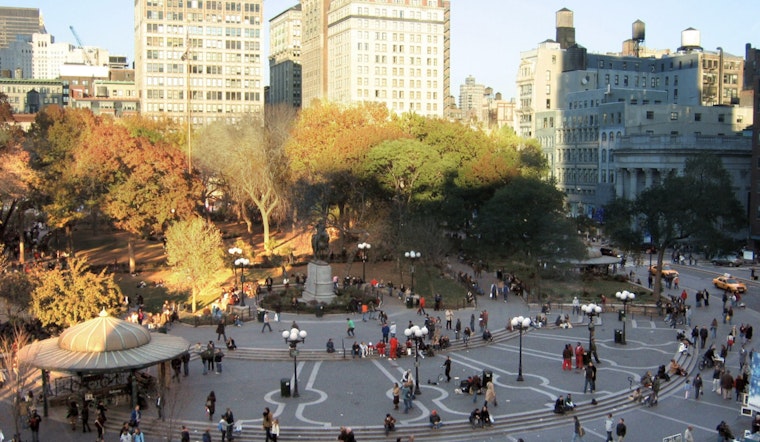
Union Square’s ground-floor retail is filling up again, and fast. Storefront occupancy has climbed to roughly 91 percent, the highest level since the pandemic and a rare bright spot for Manhattan street retail. The rebound arrives just as city planners and the local business improvement district move ahead with a major rethink of 14th Street and a redesign of Union Square Park, raising hopes that the neighborhood’s long-discussed revival is finally sticking.
Data Show A Clear Uptick
According to the New York Business Journal, the Union Square BID finished 2025 with a formidable 91 percent storefront occupancy rate, a sign that available space across the district’s main corridors has tightened considerably.
That local milestone lines up with a broader story. The Real Estate Board of New York’s H2 2025 Manhattan Retail Report describes a boroughwide recovery in retail demand, with Union Square standing out as one of the submarkets where momentum looks particularly strong, according to REBNY.
What’s Driving The Rebound
Local market data point to rising foot traffic and a steady wave of restaurant and experiential openings as the engine behind the bounce. The Union Square Partnership’s 2025 commercial market report logged a sharp increase in visits to the district, dozens of new storefronts and 88.5 percent storefront occupancy as of June 2025. The BID ties those trends to new food-and-beverage concepts and renewed office leasing that has brought more workers back into the area, per the Union Square Partnership.
Coverage of the neighborhood has also zeroed in on a large incoming food-hall anchor at Zero Irving that is expected to add more evening and weekend traffic. That project is framed as a new culinary and cultural hub in Union Square, according to new culinary and cultural hub in Union Square.
14th Street Plan Could Amplify Gains
City officials are trying to lock in that momentum with long-term changes to the streets and open spaces around the square. The New York City Department of Transportation has launched a two-year, $3 million planning study to redesign 14th Street and deliver a modernized Union Square Park, with improved plazas, landscaping and accessibility. In a March announcement, the agency said the study is being fast tracked so it can feed directly into capital projects aimed at boosting pedestrian safety and retail vitality. Public workshops and design work are already underway to shape the corridor’s next phase, according to NYC DOT.
BID Expansion And A Broader Vision
At the same time, the Union Square Partnership is weighing an expansion of its BID boundaries to pull in nearby blocks under its cleaning, safety and placemaking programs. The BID is soliciting feedback from property owners and businesses through a neighborhood survey as it refines the proposal, according to the Union Square Partnership.
The group has framed the potential expansion as part of a bigger push for a higher-quality public realm. The New York Business Journal summarized that vision as an effort to recast Union Square into something closer to a European-style gathering place, with the Partnership and its director using evocative language about making the park feel more like a piazza and the boulevard more like a grand avenue. More details on the proposal, including a downloadable map of the possible new boundaries, are available in the Partnership’s expansion materials.
Why This Matters And The Caveats
For landlords, a 91 percent storefront occupancy rate is an obvious win and a signal that the area can support new concepts, not just survival-mode holdouts. For retailers, it is a hint that Union Square may once again be a safe bet rather than a speculative play.
Market analysts, however, are not declaring victory just yet. REBNY and other observers have noted that the rebound is uneven across Manhattan, and that average asking rents in many corridors remain below their pre-pandemic peaks. Prime tourist-oriented submarkets such as Times Square and Herald Square still show higher vacancy in some measures. Investors, small landlords and neighborhood merchants will be watching closely to see whether the planned public-realm upgrades and any BID expansion turn late-2025 momentum into a durable recovery, with the wider borough trends in mind, according to REBNY.


