

























































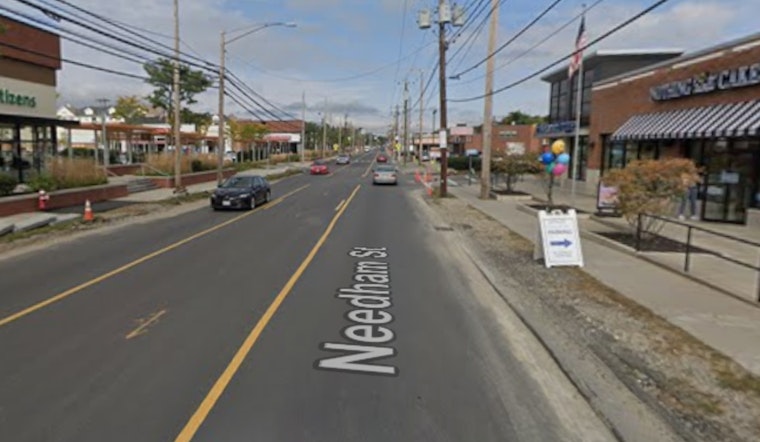
After years of neighborhood showdowns, ballot-box drama and site prep that felt like it might never end, the first new residential building in Newton Upper Falls’ Pattern District has officially hit its peak. Crews hoisted the top beam on Building 3 on Wednesday, a topping‑off moment that put a visible cap on the structure and signaled that the long‑planned project along Needham Street is now fully in its vertical era.
The 23‑acre site has been a talking point in Newton for years, but for many residents, watching steel and concrete stack into real floors made the project’s scale and schedule feel suddenly very real.
What the project will include
Developers say the Pattern District is slated to transform roughly 22.6 acres into a village‑style, mixed‑use neighborhood of apartments, shops and parks. According to Northland, the full buildout calls for about 822 apartments, including roughly 145 at affordable rents, along with about 96,000 square feet of retail space.
The plans also highlight public open space that includes a 1.5‑acre park, a restored Saco‑Pettee Mill, and a network of smaller parks and paths intended to stitch the site into the surrounding Upper Falls streets. On paper, at least, the developer is aiming for something that feels more like a small neighborhood than a standalone complex.
First phase and topping off
A topping‑off event on May 20 marked the structural completion of Building 3, the first ground‑up residential tower rising on the site, according to contractor Cranshaw Construction. The initial phase also includes renovating the historic Saco‑Pettee Mill into roughly 100 loft‑style apartments and adding two new apartment buildings that together are slated to deliver about 315 units and some 32,000 square feet of ground‑floor retail, with phase‑one construction expected to wrap in 2027, according to The Boston Globe.
In other words, Wednesday’s beam is just the opening act for a lot more concrete, glass and brick.
Neighbors and the long road to approval
“Hallelujah,” Greg Reibman, president of the Charles River Regional Chamber, told The Boston Globe at the ceremony, summing up the mood of project backers who have been riding this roller coaster for years.
The development survived a long stretch of contentious public debate that culminated in a March 2020 special election. Roughly 58 percent of voters backed the project in that citywide referendum, according to the Boston Business Journal, a result that cleared the political path for the extensive site work now underway.
For supporters, that vote was the turning point between years of planning talk and actual shovels in the ground. For opponents, it was the moment they realized the project was really happening.
Underground work and sustainability
Behind the scenes, a lot of the early work has been below the surface. Northland has highlighted heavy below‑grade construction to get the land build‑ready, including installation of rainwater‑harvesting tanks, other filtration and stormwater systems, culvert protection and the undergrounding of utilities.
The developer says it is working to daylight a historic culvert and create several acres of public green space. Engineering partners such as VHB say the site design includes stormwater recharge features, multimodal connections and other measures intended to limit runoff and encourage walkability, so the project does not function like a giant paved island.
What’s next
Cranshaw Construction and the developer outline a construction timeline that stretches through 2029 as the multi‑year buildout rolls forward. Permits, utility tie‑ins and phased building deliveries are expected to be staggered across seasons, turning the site into a long‑running construction zone and, eventually, a fully occupied district.
Leasing plans for the retail spaces and a more precise schedule for opening the parks and other public amenities are slated to come later. The project’s liaison committee and city officials say they will keep public meetings on the calendar as work continues, giving neighbors regular chances to weigh in on everything from traffic to tree planting.
For Newton, this topping‑off marks a shift from years of promise to visible product. The Pattern District is now both an active construction site and a new piece of the city’s built fabric, and the next stretch of work will test whether the finished neighborhood matches the village‑style vision that backers sold to voters back in 2020.





