

























































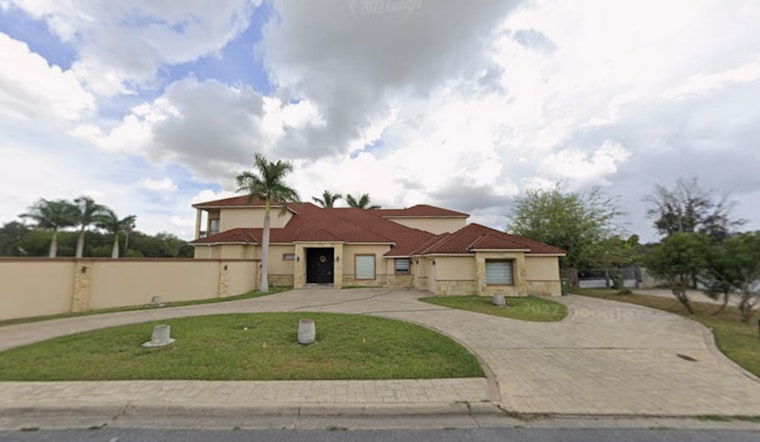
A six-bedroom Spanish Colonial Revival mansion in Brownsville that federal prosecutors say was bought and tricked out with drug proceeds is now headed for a government auction. The more than 6,900-square-foot home sits on just over an acre, with a pool, pool house and private playground. Prosecutors say the property belonged to Juan de Dios Gomez-Gonzalez, the alleged leader of a multistate cocaine trafficking ring who was killed in a shootout in September 2023.
On Wednesday, a federal judge signed a final order of forfeiture, clearing the way for the government to move the house into the public-sale pipeline, according to the U.S. Attorney’s Office, Southern District of Texas. Officials say no outstanding claims to the property remain on the record.
The house at 305 W. Cowan Terrace was bought in February 2013 for $330,000 and later appraised at roughly $1.7 million after extensive renovations, as reported by MySA. The outlet notes the property backs onto a resaca just west of Brownsville’s Four Corners area and was upgraded with features that prosecutors say were funded by illegal proceeds.
What prosecutors allege
Federal prosecutors say Gomez-Gonzalez ran the Gomez-Gonzalez Drug Trafficking Organization from roughly 2009 through 2023, importing large quantities of cocaine from Mexico and moving drug money into and out of the United States, according to the U.S. Attorney’s Office, Southern District of Texas. According to the office, members of the group stored shipments in Brownsville stash houses and used businesses in Matamoros to hide drugs and bulk cash.
Prosecutors allege Gomez-Gonzalez laundered money through a Matamoros construction company called Palmas Construction and used those funds to pay for the pool, pool house and other renovations, as detailed by MySA. Court filings cited in that reporting indicate Gomez-Gonzalez was indicted but died in Mexico before he could be arrested and extradited. Records also show his widow did not challenge the government’s forfeiture effort.
Sale and next steps
The government says the Brownsville property will be sold at a public auction, but a date has not yet been set, according to KRGV. Once a sale is on the calendar, federal forfeiture and public-notice rules will govern who can file claims and how any proceeds are ultimately distributed.
Legal note
Civil forfeiture cases are brought against the property itself rather than a specific person, and under federal law the government generally must show by a preponderance of the evidence that an asset is traceable to unlawful activity, according to the Legal Information Institute (Cornell Law School). That is a lower standard than what is required to secure a criminal conviction. Property owners can attempt to fight forfeiture, including by raising an innocent-owner defense under federal rules.
The government’s public push to seize the Brownsville mansion began in 2025, when prosecutors first filed civil forfeiture papers, according to the San Antonio Express-News. Local reporting notes the case hit a new milestone this week with the final forfeiture order, and the eventual sale will offer a real-world test of how federal officials deploy seized real estate in efforts to disrupt trafficking networks in South Texas.





