

























































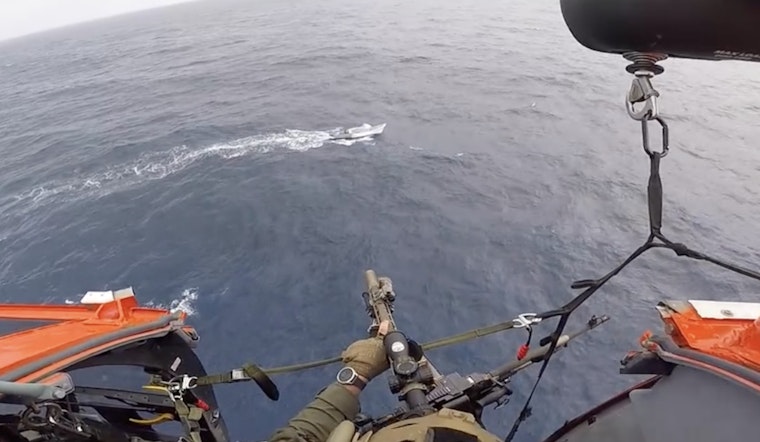
Port Everglades got an unwelcome delivery on Thursday when the U.S. Coast Guard rolled in with more than 8,000 pounds of seized cocaine, the result of a multi-boat takedown off the coast of Colombia. Packed aboard the cutter Tahoma, the drugs carry an estimated street value of about $62 million. Crews, backed by a helicopter, disabled a suspected smuggling boat at sea, pulled people from the water after they jumped overboard, and hauled both suspects and contraband back to South Florida.
How the interdiction unfolded
According to the U.S. Coast Guard, Tahoma’s crew and a deployed Helicopter Interdiction Tactical Squadron aircrew stopped three suspected smuggling vessels on Friday, May 8, roughly 90 miles off Cartagena. Crews seized about 6,085 pounds of cocaine in those operations, with the cutter later offloading approximately 8,185 pounds at Port Everglades.
Cmdr. Nolan Cuevas, Tahoma’s commanding officer, said in a statement that the interdiction prevented a significant amount of illegal narcotics from ever reaching the United States. Officials report that those pulled from the water and detained in the operation had no reported injuries, a rare piece of good news in a high-stakes game that usually has few soft landings.
Video shows aggressive tactics at sea
The Coast Guard released video that shows just how tense these chases get, as reported by the Miami Herald. In the footage, a door gunner fires warning shots in front of a suspected smuggling vessel while a marksman uses a rifle to knock out the boat’s engines. As people jump overboard, Coast Guard crew members toss flotation devices and move in for the rescue.
The video, released alongside the agency’s statement, shows suspected smugglers being pulled from the water with no reported injuries, before small-boat crews close in to complete the boardings after the helicopter team has disabled the engines.
Part of a broader surge in maritime seizures
This offload is just one in a string of big at-sea busts. In 2025 alone, Coast Guard crews confiscated more than 511,000 pounds of cocaine, which the service says is more than three times its annual average, according to the U.S. Coast Guard. Officials link that surge to stepped-up operations in the Caribbean and eastern Pacific, including Operation Pacific Viper.
Those intensified patrols have led to multiple large offloads in South Florida over the past year. The Coast Guard says maritime interdiction not only hits criminal networks in the wallet but also keeps large quantities of cocaine from filtering into American communities.
What happens next
Behind the scenes, the follow-up work is just getting started. Joint Interagency Task Force South, based in Key West, coordinates detection and monitoring efforts across the Caribbean and eastern Pacific and backs up the Coast Guard during the law-enforcement phase, according to Joint Interagency Task Force South.
Port Everglades now doubles as both a busy commercial hub and an evidence-processing site, serving as the regional offload point for the haul while federal and international partners work to trace where the shipments came from and how they tie into broader smuggling networks.





