

























































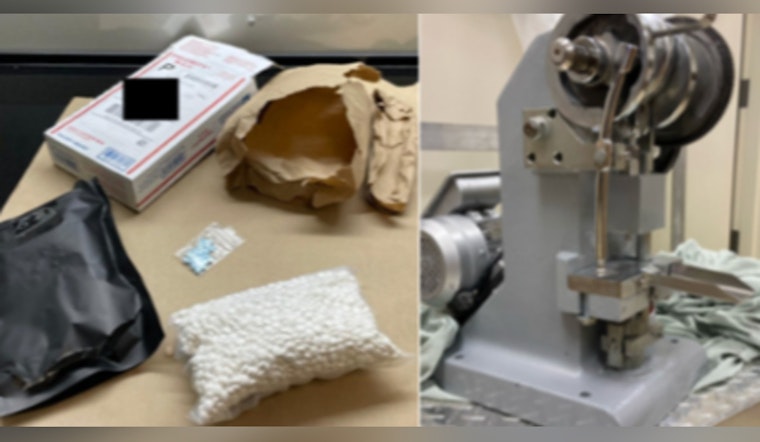
Federal prosecutors say a trans-Pacific pill pipeline ran from China to Las Vegas, churning out hundreds of thousands of fake prescription tablets laced with a lab-made opioid that is even stronger than fentanyl.
A Chinese national and a Las Vegas man were indicted Monday on federal charges accusing them of importing the powerful synthetic opioid protonitazene from China, then having it pressed into counterfeit pills for distribution across the United States. Prosecutors say the scheme, which allegedly kicked off around September 2024, turned small quantities of the drug into vast batches of potentially lethal tablets.
The indictment names Jia Guo and Seven Schmidt. According to the U.S. Attorney's Office for the Southern District of Florida, Guo is accused of coordinating procurement and shipment of protonitazene from China, while Schmidt allegedly ordered distribution-level quantities and arranged shipments from South Florida to Nevada using the U.S. Postal Service.
An associate in Miami-Dade County allegedly used pill presses to manufacture counterfeit prescription tablets that were then distributed to dealers around the country. China's Ministry of Public Security seized 10 parcels tied to the operation, prosecutors say. Both defendants are charged with conspiracy to import protonitazene and conspiracy to possess it with intent to distribute.
Why protonitazene is so dangerous
Protonitazene belongs to the nitazene class of synthetic opioids, a family that has been quietly worrying federal prosecutors and forensic labs because of its extreme potency. Officials say these drugs can be multiple times more powerful than fentanyl, which is already a leading driver of overdose deaths.
In a recent case, the U.S. Attorney’s Office in Manhattan said laboratory testing identified protonitazene in illicit tablets and described it as up to three times stronger than fentanyl. Federal regulators moved related nitazenes into Schedule I earlier this year, placing them alongside substances considered to have a high potential for abuse and no accepted medical use.
That level of potency, combined with the tiny quantities needed per pill, is why officials say roughly 200 grams of raw protonitazene can be pressed into hundreds of thousands of counterfeit tablets. When the active ingredient is that strong, the margin for error is razor thin.
How investigators say the operation worked
Court records summarized in the U.S. Attorney's Office for the Southern District of Florida release say the scheme began around September 2024. Guo, using online aliases that included "idmaster21" and "OXY GUY," allegedly arranged shipments of protonitazene to co-conspirators in the United States.
An associate in Miami-Dade is accused of using industrial pill presses to turn the imported powder into counterfeit tablets. Prosecutors say Schmidt then ordered those pills and had them mailed from South Florida to Nevada via the U.S. Postal Service, setting up a flow of fake prescription drugs into Las Vegas and beyond.
Chinese authorities arrested Guo and a freight forwarder in April 2026 and seized 10 parcels that prosecutors say were headed for recipients in the United States. Those packages are tied to the same alleged trafficking network described in the indictment.
Wider context and public health warnings
Federal officials have been sounding the alarm for years about counterfeit pills that look like legitimate prescription medications but are secretly pressed with fentanyl or other potent synthetics. The slogan is blunt: "one pill can kill." With protonitazene and other nitazenes in the mix, that warning gets even sharper.
The DEA highlights this risk in its One Pill Can Kill campaign, and the CDC offers a toolkit on fentanyl and overdose prevention. Both urge communities to expand access to naloxone, use drug-checking services where they are available, and treat any pill that does not come directly from a pharmacy as potentially deadly. Public-health advocates say enforcement efforts need to be paired with harm-reduction services in order to reduce overdose risk.
What’s next
Guo and Schmidt are expected to face federal prosecution under the Homeland Security Task Force initiative, with the case listed under docket number 26-cr-20161 in the Southern District of Florida. Each defendant faces the statutory penalties attached to the two conspiracy counts, including up to 20 years in prison if convicted.
For now, the charges remain allegations that prosecutors will have to prove in court. Future filings, hearing dates, and case developments will appear on the federal docket as the case moves forward.





