

























































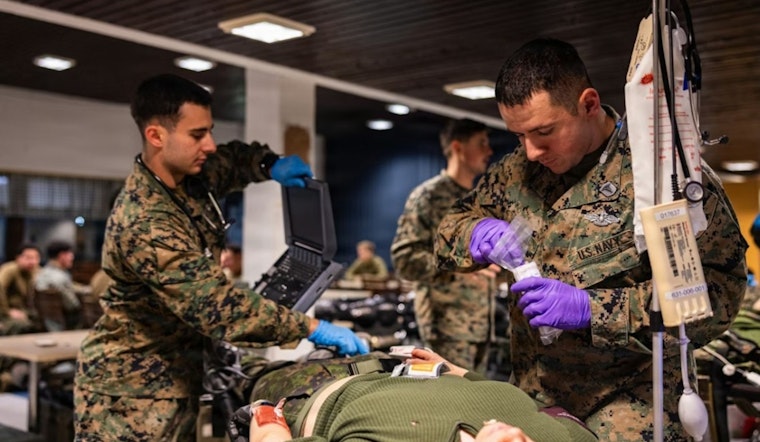
At Fort Bragg last month, more than 400 Army medics and special‑operations medical personnel packed into a briefing to hear a blunt warning from Ukrainian surgeons: small attack drones have made evacuations so risky that the once‑sacred “golden hour” is often history. The visitors described wounded fighters left without care for hours or even days, and showed cases where delayed extraction cost limbs even when the patients ultimately survived. Those frontline lessons are already nudging training and equipment changes at U.S. bases.
Ukrainian surgeons laid out grim case studies
The delegation, organized and brought to Fort Bragg by Carolina MEdiC, a UNC Health military‑civilian partnership, walked medics through the realities of working under near‑constant aerial surveillance and swarm attacks. One surgeon, who asked to be identified only by his first name, Taras, said the team at times could not evacuate a casualty for days, telling the audience that “a person can be without any type of aid, even medical aid, for a week.” As reported by WUNC News, the visit mixed classroom briefs with a live exercise that showed in real time how drones stretch casualty timelines.
Drones have reshaped casualty patterns
That shift is backed by data, not just war stories. An analysis of the conflict zone found that drone‑inflicted casualties grew from a single‑digit share in 2022 to roughly 70–80% by 2025 as production and employment of small strike drones ramped up sharply. The report tracks how cheap, mass‑produced first‑person‑view and one‑way attack drones have widened the battlespace and turned rear areas into dangerous ground for medical movement. A February study by the French Institute of International Relations details the surge in drone lethality and output. IFRI reported that spike and its operational fallout.
Golden hour becomes a golden day
Western militaries say the practical impact of unblinking drone surveillance is that evacuation timelines stretch from minutes into hours or even days, a change NATO called out directly in a recent innovation briefing. Allied Command Transformation found that evacuation delays of 60 to 120 minutes are now common in Ukraine, and that medics need low‑signature shelters, unmanned extraction tools and new command‑and‑control systems to work with any level of safety. The alliance has pressed for rapid prototyping of such solutions in response to those battlefield lessons. NATO Allied Command Transformation highlighted those priorities.
U.S. medical doctrine is adjusting
U.S. Army medical planners and analysts now point to Ukrainian innovations, including hardened and often subterranean stabilization points close to the front, as blueprints for future large‑scale conflicts. An Army analysis recommends decentralizing surgical capabilities and training medics for prolonged field care, since rapid evacuation to higher‑level surgical hubs may not be realistic under sustained drone pressure. The Army paper frames those moves as essential for sustainment in contested environments. The U.S. Army review draws explicit lessons from Ukraine’s experience.
Training changes at Fort Bragg and Camp Lejeune
Those takeaways are already showing up in U.S. training. UNC Health’s military‑civilian program is running combat casualty courses that pair Ukrainian surgical teams with units from the 44th Medical Brigade, and program managers say the aim is to push lifesaving skills and prolonged‑care techniques much closer to the point of injury. Program staff told attendees that the Pentagon recognizes the problem and is exploring ways to shield forward care while teaching medics to stabilize patients for far longer stretches. As reported by WUNC News, the classroom work was paired with a field exercise featuring drone‑delivered resupply and casualty‑movement drills.
Medical standards are under strain
Longstanding clinical guidelines assume relatively short tourniquet times and quick evacuation, and tactical combat‑care doctrine calls for reassessing and converting tourniquets within roughly a two‑hour window when conditions allow. Longer evacuation timelines raise the risk of ischemic injury, rhabdomyolysis and limb loss, and Joint Trauma System guidance warns medics to be cautious about tourniquet conversion and monitoring when transport is delayed. The JTS prolonged‑field‑care guidance spells out the clinical dangers and step‑by‑step measures medics should use as evacuation times expand. Joint Trauma System guidance summarizes those limits and how to blunt the damage.
For Fort Bragg medics, the takeaway is concrete and immediate: train to keep casualties alive for longer stretches, harden or hide critical care sites, and rehearse low‑signature casualty movement under an active aerial threat. Commanders and medical leaders are experimenting with technologies and tactics, from autonomous extraction platforms to buried or hardened role‑2 facilities, that could be the difference between life and death when drones dominate the sky.




