

























































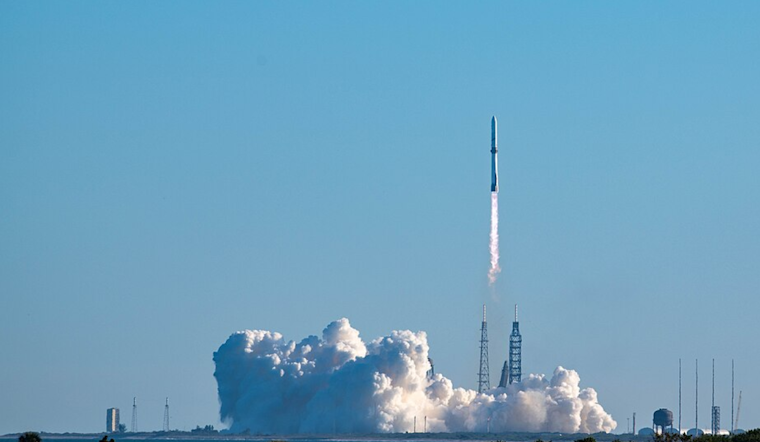
Blue Origin is angling to get its New Glenn heavy-lift rocket back on the pad in early June, lining up a return-to-flight mission from the Space Coast a little more than five weeks after the vehicle was grounded over an upper-stage anomaly. If that schedule holds, the NG-4 launch would be the first New Glenn flight since April's mishap and the first to haul Amazon's latest batch of low Earth orbit satellites. Local launch fans and suppliers on Merritt Island are watching closely as regulators and engineers work through the final checks.
The Federal Aviation Administration has cleared New Glenn to fly again and placed the NG-4 mission on its operations-plan advisory with a tentative window opening as soon as June 4 from 1:21 to 3:03 p.m. local time, according to the Orlando Sentinel. The NG-4 payload, listed as LN-01, would be the first New Glenn mission to add satellites to Amazon's LEO constellation and is slated to carry 48 satellites, the Sentinel reports. Range availability and a final round of FAA verification on Blue Origin's corrective steps will still determine whether that early June plan sticks.
What regulators found and what Blue Origin changed
The FAA oversaw Blue Origin's investigation into the April NG-3 flight and accepted the company's report that one BE-3U upper-stage engine suffered a cryogenic leak that froze a hydraulic line and produced a thrust anomaly, according to Manufacturing Dive. The agency said Blue Origin identified nine corrective actions to prevent a repeat and closed its review after the fixes were implemented. TechCrunch and other outlets also reported that the FAA had cleared New Glenn to return to flight once those actions were in place.
What is on the manifest and why it matters
Getting NG-4 off the ground would be a key step toward the launch cadence Blue Origin had mapped out for this year. Company leaders had been aiming for multiple New Glenn missions in 2026, and this first Amazon LEO flight would kick off what is planned to be as many as two dozen New Glenn launches for that constellation. As reported by the Orlando Sentinel, the NG-4 mission will use a first stage nicknamed "no, it’s necessary" and, if successful, could help position New Glenn to start receiving national-security launch task orders under a four-flight certification path.
Space Coast implications
On the ground, Blue Origin's expansion shows how much rides on New Glenn's reliability. State officials and company materials outline a roughly 600 million dollar Project Horizon factory at Merritt Island that would add upper-stage production capacity and hundreds of jobs, per Manufacturing Dive. For local readers, Hoodline's earlier coverage of Blue Origin's test-site issues, New Glenn countdown wobbles, offers background on community scrutiny and supplier concerns. Brevard County businesses and tourism operators will be watching to see whether Blue Origin can maintain a steady tempo of launches without another interruption.
The next milestones include final FAA verification that all corrective actions are in place, Eastern Range scheduling and weather, and any updated NOTAMs or range advisories. Outlets including TechCrunch report that those pieces will determine whether the early June target holds. If NG-4 lifts off and performs nominally, it would put New Glenn back on track for more commercial LEO missions and for supporting lunar hardware later this year.




.jpg)