

























































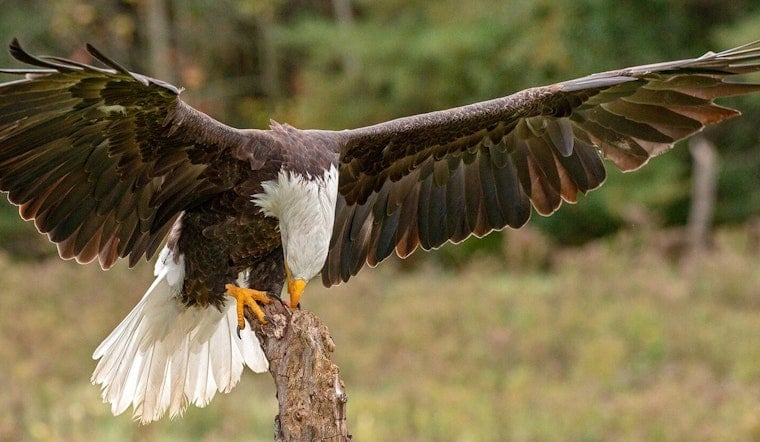
Los Angeles County has a new set of high-profile tenants, a confirmed pair of bald eagles nesting in a county park, and the Department of Parks & Recreation marked the discovery this weekend with a short video captioned, “the eagles have landed.” Officials are keeping the exact nest location secret to protect the birds from disturbance and are asking visitors, hikers and pet owners to give the eagle family plenty of room while it breeds.
County Video Sparks Buzz, Officials Say: Back Up A Bit
As reported by KTLA, the county parks department posted video of the duo squawking high in a pine tree and repeated the line, “the eagles have landed.” The agency stressed that disturbing active nests can disrupt breeding and urged people to watch from a distance, keep dogs on leashes, skip flying drones anywhere near nests and hold off on tree trimming around potential nest trees. Anyone who finds an injured or distressed nesting bird is asked to contact the San Dimas Raptor Rescue at (626) 559-5732.
Legal Protections For Bald Eagles
Bald eagles are covered by a web of federal and state protections that make it illegal to kill, take or disturb the birds, their nests or their eggs. The U.S. Fish & Wildlife Service enforces both the Bald and Golden Eagle Protection Act and the Migratory Bird Treaty Act, while the California Department of Fish and Wildlife classifies bald eagles as fully protected and issues guidance on how close people and projects can come to nests. The U.S. Fish & Wildlife Service and the California Department of Fish and Wildlife have more on those rules.
What Neighbors Might See At The Nest
Across most of California, bald eagles generally breed from January through July or August, lay one to three eggs and incubate them for about 35 days, so if this pair has eggs, they may be sitting tight on the nest for the better part of a month. The county’s video shows classic behavior, loud calls and nest‑arranging high in a pine, and staff warned that people lingering too close to a nest tree can cause parents to abandon eggs or chicks. KTLA reported on the department’s post and clip.
Comeback Story Playing Out In Local Parks
Years of habitat protection and restoration have helped bald eagles rebound around California, and the California Department of Fish and Wildlife says nesting territories have steadily expanded in recent decades. Local parks, watershed reservoirs and foothill woodlands are now seeing more nesting pairs, which is great for wildlife watchers but also means more need for monitoring and public education to reduce disturbances near nests. CDFW tracks the species’ distribution and biology.
How To Watch Without Stressing The Birds
For anyone hoping to catch a glimpse, officials recommend bringing binoculars, sticking to marked trails and resisting the urge to creep closer for photos or video. For injured raptors or possible disturbance of an active nest, county listings identify the San Dimas Canyon Nature Center as the local natural-area hub, and its programs include a raptor rescue, so visitors are urged to check the park’s page for contact details and hours. San Dimas Canyon Nature Center.





