

























































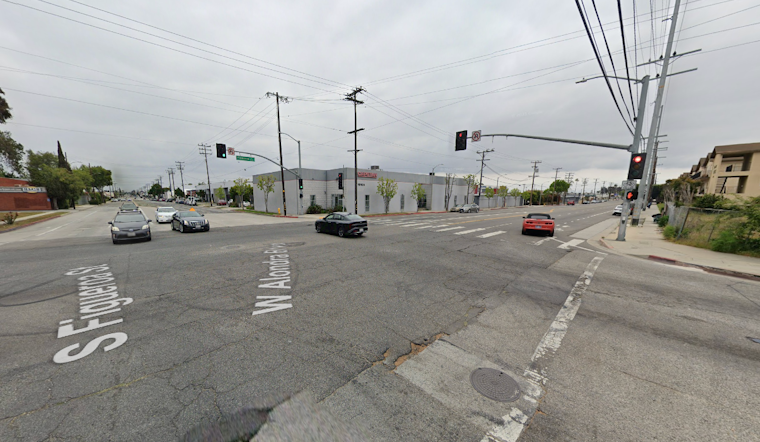
Los Angeles Councilmember Tim McOsker introduced a motion Wednesday demanding the city use every available tool, and develop new ones if necessary, to stop street takeovers that have turned the intersection of Figueroa Street and Alondra Boulevard in Harbor Gateway into a recurring hotspot for reckless driving, road closures and looting.
The motion, first reported by the Los Angeles Daily News, directs the LAPD, the Los Angeles Department of Transportation, the City Attorney's Office and other city departments to evaluate enforcement and prevention strategies and identify existing and additional tools to combat the illegal gatherings. Reporter Donna Littlejohn detailed how the events, which draw large crowds and dozens of recklessly speeding vehicles, have become a nuisance in Harbor Gateway, shutting down intersections and, at times, leading to nearby stores getting looted.
“The city should use every existing tool and establish more if needed to prevent takeovers and hold participants accountable,” McOsker said, according to the Daily News. He added that Los Angeles residents should not have to pay for public-property damage caused during illegal takeovers, and said the city should pursue every lawful avenue to recover those costs.
Streets, Curbs and Signs Left Damaged
Street takeovers frequently damage streets, roadway markings, curbs, signs and other public infrastructure, per the motion. McOsker's proposal directs the city to examine financial accountability for that damage, with the City Attorney's Office and relevant departments expected to report back on ways to recover repair costs for damaged city property, including crosswalks, roadway striping, signage and curbs.
The events put nearby residents, motorists, pedestrians, first responders and the participants themselves at risk, the motion states. Harbor Gateway is far from alone: street takeovers occur during summer months across many Southern California cities and neighborhoods, a pattern Hoodline has tracked as it has repeatedly spilled into organized retail theft targeting businesses like AutoZone stores and convenience stores across South LA, East LA, Watts and Downey.
Figueroa Street in Harbor Gateway has a documented history with this kind of chaos. In August 2022, a takeover at Figueroa and El Segundo Boulevard escalated into what CBS News described as a flash-mob looting of a nearby 7-Eleven, where more than 100 participants ransacked the shop, stole merchandise and threw items at an employee.
Impounds, Citations and Roadway Redesigns on the Table
McOsker's motion calls for stronger administrative citations and penalties for both participants and organizers, along with expanded investigative technology where appropriate and legally permissible. It also includes evaluating vehicle impoundments of up to 30 days where legally allowed — an option grounded in California Vehicle Code Section 23109.2, which permits law enforcement to impound vehicles used in illegal speed contests, exhibitions of speed or street takeovers for up to 30 days at the registered owner's expense, according to Justia Law.
The motion also calls for evaluating roadway and traffic improvements designed to deter or disrupt recurring takeovers at Figueroa and Alondra and elsewhere in Harbor Gateway. Municipalities across Los Angeles County have already deployed physical traffic-calming infrastructure for this purpose, including raised ceramic Botts' dots markers, hardened curb extensions and traffic circles meant to disrupt tire traction and impede stunt driving, according to a report presented to the Los Angeles County Board of Supervisors.
Tighter State Penalties Already in Place
The motion builds on a legal framework state lawmakers have tightened in recent years. In September 2024, Governor Gavin Newsom signed Assembly Bill 2807, which codified sideshows and street takeovers as identical offenses under state law, closing loopholes defense attorneys had previously used, according to the Office of Governor Gavin Newsom. Assembly Bill 3, which took effect in July 2025, now authorizes state courts to suspend a convicted driver's license for 90 days to six months when a reckless driving or exhibition-of-speed violation occurs as part of a sideshow or takeover.
Locally, Los Angeles Municipal Code Section 47.15 already prohibits spectators from standing within 150 feet of an illegal street race or takeover on public roadways, making it a misdemeanor or infraction punishable by fines up to $500. LAPD's Street Racing Task Force has shown what a coordinated crackdown can look like: during one multi-division operation in South LA and surrounding areas, officers disrupted five takeovers in a single night, resulting in 24 misdemeanor arrests, 13 spectator citations and 14 vehicle impounds lasting 30 days.
Part of a Citywide and Regional Pattern
McOsker's motion fits into a broader push by Los Angeles-area officials to choke off takeovers at their source. In July, Los Angeles County officials advanced a proposal to amend Chapter 13.46 of the county code, raising misdemeanor fines up to $1,000 specifically for organizers, promoters and social media influencers who coordinate the events — a plan Hoodline detailed in its earlier coverage of the county's crackdown push. A separate March 2026 motion filed with the Los Angeles City Clerk flagged a Downtown location at 12th and Figueroa streets as one of 50 high-priority intersections citywide identified for recurring street-racing and takeover activity.
The pattern has continued to play out across the region this summer. Hoodline has reported on a 50-car takeover that overwhelmed Figueroa Street in Downtown LA, an East LA AutoZone ransacked during a takeover at Olympic and Atlantic, and a Downey takeover that ended with four arrests after an AutoZone and Spirit Halloween store were hit. Separate takeovers in South LA and Boyle Heights have also turned violent this summer, with shootings reported at both scenes.
McOsker's motion will next go to the council's public safety and public works committees before returning to the full Los Angeles City Council for a final vote. As part of that process, the City Attorney's Office and relevant departments are expected to report back on criminal and civil enforcement options available to the city.




