

























































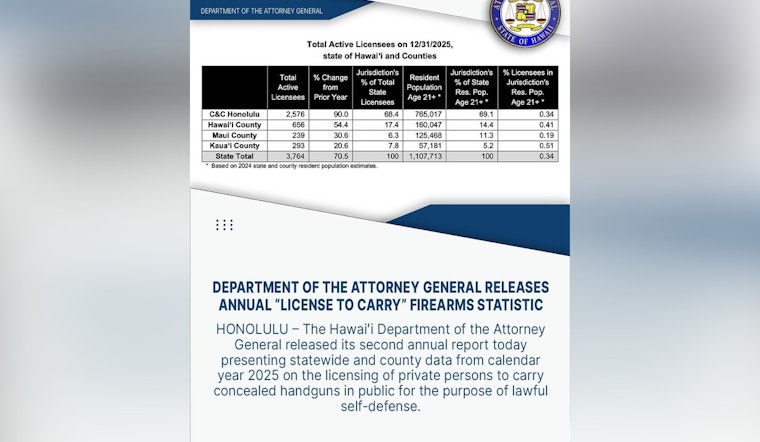
Hawaii’s concealed-carry landscape shifted sharply in 2025, with 3,764 people holding a valid license to carry a concealed handgun on Dec. 31, 2025. That works out to roughly 0.34% of residents age 21 and older, yet it marks a 70.5% jump from the 2,207 licensees counted at the end of 2024. Most of that surge was centered on Oʻahu, where county police handled nearly 2,000 new applications amid ongoing legal changes and courtroom battles over where guns can be carried.
The Attorney General’s new annual report pulls together 2025 licensing activity, county-by-county numbers and plenty of fine print about what the figures actually mean. It notes that some applications and outcomes spill across multiple calendar years and that the 2025 total folds in still-valid licenses issued in 2024, which muddies any simple year-to-year rate comparison. The publication also adds demographic tables and county-level data for the first two years of statewide reporting, according to the Hawaiʻi Department of the Attorney General.
All four counties saw their numbers climb. The City and County of Honolulu recorded a 90.0% increase, Hawaiʻi County rose 54.4%, Maui County went up 30.6%, and Kauaʻi County posted the smallest gain at 20.6%. Honolulu alone accounted for 2,576 of the state’s active licensees, according to Hawaii News Now. Local reporting also notes that licensee shares do not always track neatly with county population shares, with some outer-island counties over‑represented in the totals.
Statewide in 2025, county police departments received 1,994 new license-to-carry applications and issued 1,968 licenses. They denied 38 applications and revoked eight licenses during the year. According to the Attorney General’s breakdown, the most common denial reasons were lacking the essential character or temperament to be entrusted with a firearm, legal disqualifications or failing to file a properly completed application. All character-based denials were reported by the Honolulu Police Department, as detailed in the Hawaiʻi Department of the Attorney General report.
Why the numbers climbed
The spike comes in the wake of legal and legislative shifts following the U.S. Supreme Court’s 2022 Bruen decision, which forced states to revisit public-carry rules. Hawaii’s post-Bruen law package included new limits on “sensitive places” and a revised licensing regime, and the U.S. Supreme Court heard a separate challenge this term to the state’s private-property consent rule. National coverage of those oral arguments suggested the justices were skeptical of Hawaii’s approach, according to the AP.
What applicants should know
State law requires county police chiefs to provide licensing data to the Attorney General and spells out how denials and revocations must be reported and appealed. The basic framework is set in Hawaii Revised Statutes §134‑9.6. According to local reporting and the AG’s release, four administrative appeals were filed in 2025: two were granted, one was denied and one remained pending at year’s end. No judicial reviews were requested, Hawaii News Now reported.
What to watch next
The Supreme Court’s forthcoming decision in the Wolford case, expected by late June, could change where license holders may lawfully carry and, in turn, influence future application trends. Officials, business owners and gun-policy advocates say they are watching both that ruling and next year’s Attorney General numbers to see whether the 2025 jump continues or starts to level off, according to the AP.
For now, the Attorney General’s dataset offers the most detailed snapshot yet of how Hawaii’s carry landscape is evolving after the recent legal changes. The 2025 report’s county breakdowns and demographic detail set the baseline for watching whether the state’s licensing numbers keep climbing into 2026.



