

























































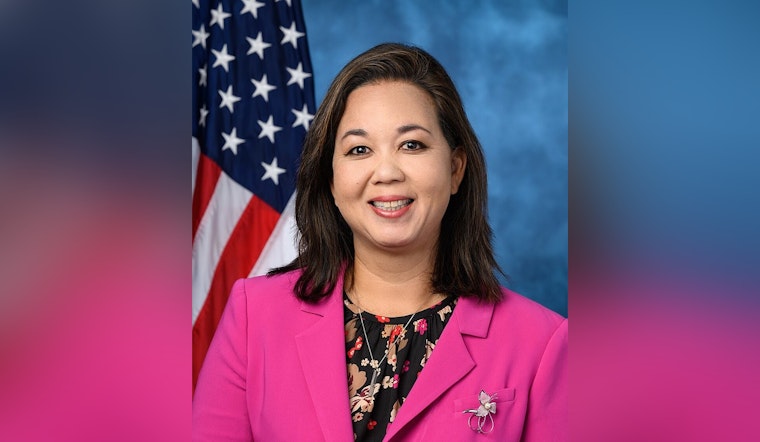
Hawaiʻi's 2nd Congressional District Rep. Jill Tokuda is drawing a clear line on Taiwan as President Trump heads to Beijing to meet with Xi Jinping, introducing a bipartisan House resolution that says, in plain terms, the island is not a bargaining chip.
Tokuda's measure, filed this week with leaders of the House Select Committee on the CCP, leans on long-standing U.S. policy tools - the Taiwan Relations Act and the Reagan-era Six Assurances - as the backbone of Washington's approach to Taiwan. She cast it as a signal from Congress during a diplomatic moment when every word from Washington and Beijing will be parsed.
The resolution was introduced alongside Select Committee Chairman John Moolenaar (R-Mich.) and Ranking Member Ro Khanna (D-Calif.), with language reaffirming that Taiwan's future must be determined only by peaceful means, according to the House Select Committee on the CCP. Khanna cautioned, "When President Trump meets with Xi Jinping in Beijing this week, Taiwan cannot be on the table," while Moolenaar called the TRA and the Six Assurances "cornerstones of a bipartisan policy" that helps preserve stability. A bipartisan roster of cosponsors from both parties is signed on, an intentional show of unity on a notoriously sensitive issue.
What the resolution says
The text restates the Taiwan Relations Act's security commitments, including that the United States will make defensive arms available to Taiwan, and it lays out the Six Assurances, such as pledges not to set a date for ending arms sales or to consult with Beijing before approving them. The full language appears in Tokuda's official filing at Tokuda.house.gov, and the resolution explicitly "reaffirms the Taiwan Relations Act, the three Joint Communiques, and the Six Assurances" as the cornerstones of U.S. policy. As detailed in congressional research on the Six Assurances at Congress.gov, those commitments remain central to how lawmakers define America's role in Taiwan's defense.
Why lawmakers acted now
Tokuda and her colleagues are pitching the resolution as a pre-emptive guardrail as Trump and Xi sit down in Beijing, where even a stray phrase about Taiwan can trigger headlines in both capitals. Chinese readouts and media coverage of the summit have heightened concern that Taiwan might surface in ways that appear to bend or blur decades-old policy. For background on the summit and the leaders' exchanges, see reporting by The Associated Press.
Why it matters to Hawaiʻi
Tokuda represents Hawaiʻi’s sprawling 2nd District and serves on the House Armed Services Committee, a perch that gives her a direct hand in shaping Indo-Pacific defense policy. That role, combined with Hawaiʻi's central place in U.S. military posture across the Pacific, helps explain why the delegation keeps a close eye on any talk of shifting U.S. commitments to Taiwan. As reported by Maui Now, Tokuda framed the move as a clear message to both U.S. allies and Beijing that American commitments are meant to be lasting and credible, not fleeting talking points.
The resolution has been formally submitted and referred to committee, where it now waits its turn on the crowded Capitol Hill calendar. Supporters are betting that its bipartisan language will give extra heft to the message of U.S. resolve. For those who want to read every clause and comma, the full text is posted at Tokuda.house.gov.



.jpg)