

























































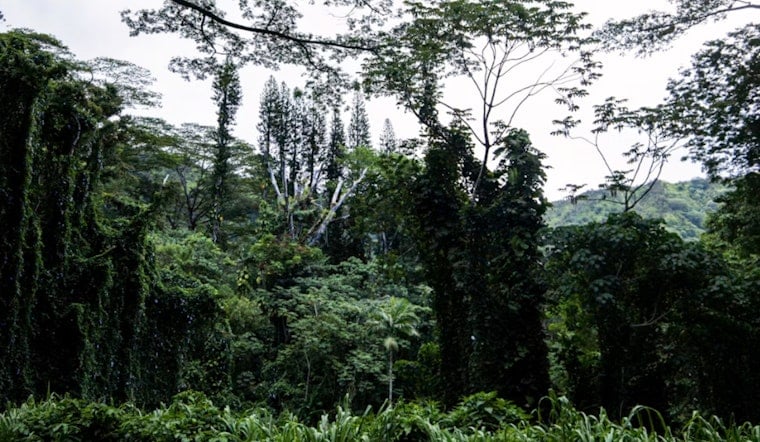
A new University of Hawaiʻi study says some of Honolulu's best future flood protection is not concrete or steel, but the native forests already clinging to the hills above town. Restoring those upland forests and keeping invasive plants in check in Oʻahu's watersheds could significantly cut flood damage across urban Honolulu. Researchers modeled how canopy recovery and invasive-species removal change runoff, sediment and erosion, and concluded those natural fixes can ease pressure on canals, pumps and other engineered defenses. The finding lands in the wake of the March 23 flash flood in Mānoa that overtopped the Woodlawn Bridge and flooded nearby homes, including the grounds of Noelani Elementary School.
The analysis, produced by the University of Hawaiʻi Economic Research Organization, blended hydrological monitoring with land-cover and economic modeling to estimate how different watershed management choices could play out, according to University of Hawaiʻi News. Researchers ran scenarios for the Makiki, Mānoa and Pālolo watersheds and looked at how protecting native canopy and removing aggressive non-natives would shape future flood outcomes. One major aim was to see how ecological restoration stacks up against relying only on dredging and other hard infrastructure.
On the money front, the report flagged some steep potential costs if nothing changes. Annual Ala Wai Canal dredging expenses could grow from about $1.4 million to roughly $3 million under higher-runoff scenarios, and annual flood damages in the modeled area could nearly double from about $68 million to $134 million by 2036, per UHERO's findings. Those projections fold in property damage, infrastructure hits and emergency-response costs tied to changing runoff and sediment loads. The authors argue that investing in watershed protection now can ease those recurring maintenance and repair bills over time.
Field monitoring in the study turned up a telling pattern. After invasive-species removal and native-vegetation recovery, streamflow for a given rainfall amount dropped in Makiki and Mānoa, a sign that restored forests can soak up more water before it barrels into lowland drains, according to University of Hawaiʻi News. The study examined the roles of fast-growing albizia and invasive miconia, both known for opening slopes and speeding up erosion. Lower peak flows mean less sediment flushed into the Ala Wai, which helps explain why dredging there has become so frequent and costly.
How Forests Blunt Floods
Native forests help tame flood risk by catching rainfall in their canopy, boosting how much water the soil can absorb with dense root networks and bracing slopes against landslides and gullying. By holding water higher in the landscape and out of storm drains, restored forest cover trims peak flows and cuts the volume of sediment carried into urban channels. The study's authors stress that those ecosystem services are meant to work alongside, not instead of, engineered solutions like pumps and canal maintenance.
What This Means for Honolulu
For Honolulu policymakers, the research points to a hybrid playbook in which nature-based and engineered strategies share the workload and, potentially, lower the overall price tag compared with dredging alone. The authors call for steady funding for invasive-species control and native reforestation so existing and future projects can mature and deliver their full protective punch. Local agencies, they note, will have to juggle immediate maintenance demands with longer-term investments in watershed health as climate change ramps up storm intensity.
The UH study effectively recasts native forest protection as a kind of slow-build infrastructure investment: it takes longer to grow than concrete cures, but it offers durable payoffs when it comes to runoff, erosion and repeated repair bills. With the Mānoa flooding still fresh in neighborhood memories, the report gives city planners a concrete, research-backed reason to prioritize the upland forests that help keep Honolulu dry.




