

























































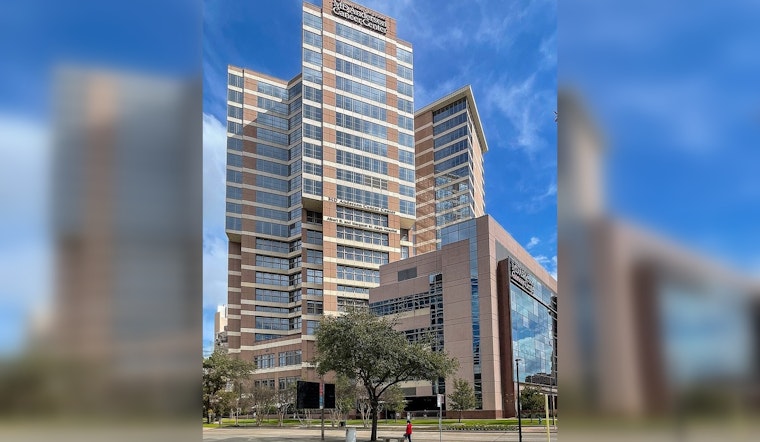
A Houston woman who once faced stage 4 melanoma is now showing no evidence of disease after joining a surgical brachytherapy clinical trial at UT M.D. Anderson Cancer Center, where surgeons implanted tiny radiation “tiles” directly into her brain at the time of tumor removal.
Instead of waiting weeks to start standard post-operative radiation, the dissolvable, tile-like wafers began delivering radiation immediately to the surgical cavity. Early randomized phase 3 data, presented this week at the American Society of Clinical Oncology (ASCO) meeting, suggest this approach can sharply cut the risk that brain metastases grow back.
UT M.D. Anderson profiled the patient, Stacy Dixon, who was first diagnosed with melanoma in 2016 and underwent a craniotomy there on Nov. 18, 2022. According to the cancer center, she later had a second operation in February 2025 to check out “shadows” on imaging but has continued to show no evidence of disease since that first brain surgery.
Dixon told UT MD Anderson she "trusted my care team" and said she appreciated that the tiles start working right away in the operating room.
The randomized Phase 3 ROADS study enrolled about 204 patients at roughly 32 centers and compared intraoperative, tile-based brachytherapy with standard post-operative stereotactic radiation. Early results presented at ASCO show surgical-bed recurrences dropped from double-digit rates with external radiation to roughly 1% with the tiles, and recurrence-free survival in the tile arm had not been reached at a median 12.9 months of follow-up. Those topline findings were summarized by Managed Healthcare Executive.
How the implant works
The implant, commonly known by the trade name GammaTile, is a bioresorbable collagen square studded with multiple cesium-131 seeds that surgeons line along the cavity surface as soon as the tumor is removed so radiation can start immediately.
According to the manufacturer, each tile contains four Cs-131 seeds, and the collagen carrier slowly dissolves as the short, intense dose is delivered. The design is intended to focus radiation on the surgical site while limiting exposure to healthy brain tissue. The device maker also notes that this technique ensures patients receive the full prescribed local dose without waiting weeks to begin post-operative radiation appointments, per GT Medical.
ROADS findings and what comes next
MD Anderson researchers who co-led the ROADS trial reported at ASCO that one-year surgical-site recurrence was 1.3% for patients treated with tile implants, compared with 15.4% for those who received stereotactic radiation. Median overall survival was also longer in the tile arm.
The trial was co-led by Jeffrey Weinberg and Thomas Beckham. Weinberg told UT MD Anderson the technique is "not just \"as good as,\" but superior to the other way."
The ROADS study is registered on ClinicalTrials.gov as NCT04365374 and was sponsored in part by the implant manufacturer, which issued a release saying the data support broader adoption of tile-based therapy. Longer follow-up and wider implementation will determine how quickly surgeons and radiation oncologists change practice, but for patients like Dixon, the immediate radiation delivered during surgery appears to have made a tangible difference.





