

























































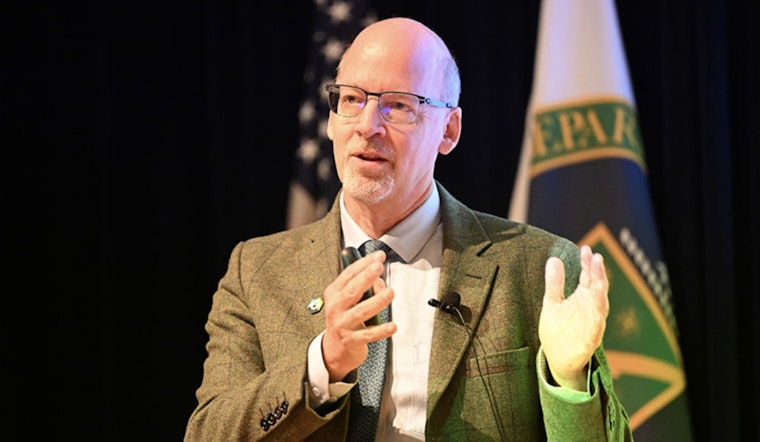
John Hill, a career physicist who has spent more than three decades at Brookhaven National Laboratory, officially became the lab's director on May 21, 2026, after serving as interim director since September 2025. He takes charge of the Upton, Long Island campus at a moment of major transition, as the site pivots from Relativistic Heavy Ion Collider operations to next-generation projects and upgrades, putting a familiar insider in charge during a decade of big construction and facility work.
Brookhaven Science Associates selected Hill after an international search and will also make him president of the organization that runs the lab, according to Brookhaven National Laboratory. The announcement notes that he will oversee roughly 3,000 scientists, engineers and staff and manage an annual budget of about $900 million, with BSA board members highlighting his leadership on photon-science and accelerator programs as central to Brookhaven's next phase.
"Brookhaven is entering a defining decade, and I'm honored to take on this role at this time," Hill said as he accepted the post, outlining priorities that range from new colliders to advances in AI and quantum systems. Hill joined Brookhaven as a postdoctoral researcher in 1992 and has since led NSLS-II operations, served as deputy associate laboratory director for energy and photon sciences, and been deputy director for science and technology, experience the lab says has prepared him to steer the institution, according to Brookhaven National Laboratory.
What Hill Will Lead on Long Island
A major part of Hill's agenda will center on delivering the Electron-Ion Collider, the multibillion-dollar nuclear physics facility the Department of Energy selected Brookhaven to host in 2020. The department estimated the project would cost between $1.6 billion and $2.6 billion and take roughly a decade to build, according to the Department of Energy. Science coverage has commonly rounded that figure to about $2 billion, reflecting the project's multiyear scope and complex procurement work still to come, as noted by Physics World.
Brookhaven will also continue to rely heavily on its National Synchrotron Light Source II, a project whose total cost was set at about $912 million and which opened to users in 2015, a capability that underpins much of the lab's materials and imaging research, per Congress.gov. Keeping NSLS-II at peak performance while construction ramps up elsewhere on campus will be one of Hill's operational juggling acts.
The Relativistic Heavy Ion Collider wrapped up its final collisions on Feb. 6, 2026, after 25 years of operation, marking the start of work to repurpose accelerator components for the EIC, a milestone that set the stage for the next project phase. Phys.org and other outlets covered the final run and its role in the EIC transition.
Operationally, Brookhaven is run for DOE by Brookhaven Science Associates, a partnership between Battelle and The Research Foundation for the State University of New York on behalf of Stony Brook University. That governance structure links the lab to regional universities and industry and amplifies its local workforce and economic impact, according to Stony Brook University.
Hill's appointment signals continuity more than rupture, a promotion for a leader steeped in Brookhaven's technical culture who now has to convert decades of facility know-how into timely construction, budget discipline and community engagement. For Long Island and for U.S. nuclear and photon-science communities, the coming years will test whether that stewardship can turn a "defining decade" into enduring scientific and economic gains.





