

























































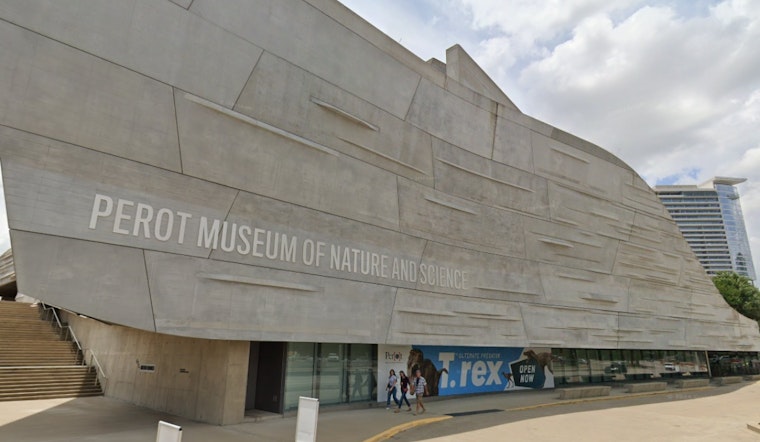
North Texas now has its very own sea monster headliner. A Dallas-area team of paleontologists and museum researchers has identified a new species of mosasaur, Tylosaurus rex, and the name-bearing skeleton is already on public display at the Perot Museum of Nature and Science. The creature, billed as a "T. rex of the sea," stretched an estimated 25 to 43 feet and sported finely serrated teeth and enlarged muscle-attachment sites that point to an exceptionally powerful bite. The findings, published today in a peer-reviewed bulletin, also revise long-held ideas about mosasaur diversity in North Texas.
According to a Perot Museum press release, researchers at the American Museum of Natural History, the Perot Museum, and Southern Methodist University re-examined more than a dozen fossils that had previously been assigned to Tylosaurus proriger and concluded that the Texas material represents a distinct species. The museum notes that the holotype was first discovered in 1979 and that many of the specimens come from roughly 80-million-year-old rocks across northern Texas. The Perot statement also reports that the team assembled a revised dataset that underpins a new arrangement of tylosaur relationships, and that the work received support from the National Science Foundation and regional partners (Perot Museum press release).
Found by a Family on Lake Ray Hubbard
The name-bearing specimen first entered the story on a family boat ride along Lake Ray Hubbard in 1979, The Dallas Morning News reported. Ron Tykoski, the Perot's vice president of science and a co-author on the study, told the paper that the parents beached the boat and "the kids got a little antsy, started getting a little whiny," a bout of restlessness that led to the discovery. That specimen has been in the museum's collection for years and ultimately proved central to the researchers' decision to name the new species.
What Separates T. Rex From Its Cousins
According to the authors, several consistent features set the Texas animals apart from classic T. proriger material: finely serrated, knife-like teeth; a groove on the rim of the quadrate bone; and enlarged attachment sites for jaw and neck muscles, as detailed in the paper in the Bulletin of the American Museum of Natural History. Lead author Amelia Zietlow and colleagues note that the Texas specimens are also about four million years younger than many examples from Kansas, a combination of age and anatomy that supports naming a separate species. The study presents a revised character matrix that the team says should spur a fresh look at mosasaur phylogeny and evolution.
Battle Scars Tell a Violent Life
Some T. rex fossils carry dramatic injuries and signs of healing that point to violent encounters between large mosasaurs. The Perot press release highlights a specimen nicknamed "The Black Knight" that is missing part of its snout and has a fractured lower jaw, damage the researchers say was probably inflicted by another large mosasaur. Along with well-known mounts such as the University of Kansas "Bunker" and Yale's "Sophie," those battered fossils helped the team recognize a consistent anatomical and behavioral signal in the Texas material (Perot Museum press release).
Why North Texas Matters
Experts told Dallas News that formally naming the Texas tylosaurs sharpens questions about predator diversity, life history, and ecological interactions in the Western Interior Seaway. The study also underscores the crucial role of citizen scientists and amateur collectors in building North Texas's rich mosasaur record, since many of the specimens used in the analysis were discovered by nonprofessionals. Researchers say the updated dataset and renewed focus on Texas material are likely to change how paleontologists model mosasaur diversity and evolution going forward.
The holotype Tylosaurus rex remains on view in the Perot Museum's T. Boone Pickens Life Then & Now Hall, where visitors can see the mounted skeleton and the museum's interpretation of its injuries and anatomy. Museum hours and visitor information are available through the Perot Museum, which says it plans to continue research and exhibit updates as new work on the species progresses.





