

























































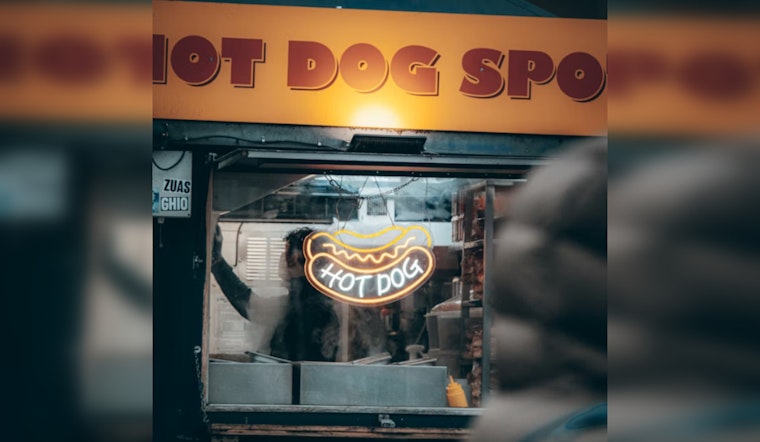
A late-night clash between unlicensed hot dog vendors spilled across West Hollywood’s Rainbow District sidewalks, leaving carts abandoned, tempers high and nearby businesses on edge. Video shared with local outlets shows two women brawling near the corner of Santa Monica Boulevard and San Vicente in the early morning hours, and bystanders say scenes like this are starting to feel like a standing weekend feature. Several operators have told local businesses the scuffle is just the latest flareup in what they see as a broader safety and labor crisis along the boulevard.
Footage and local reaction
As reported by WEHOonline, the video shows one vendor on camera identifying herself as 14 years old while working a cart at around 2:30 a.m. Business owners who shared the footage with the outlet said some vendors appear to use multiple cashless payment apps that all route into the same accounts, and described groups of so-called “enforcers” who show up to pressure staff when they ask carts to move. Owners told the site the carts have created slip hazards from grease, fire risks from equipment and ramps, and ADA problems when gear is abandoned in pedestrian paths.
Why business owners say the system fails
Nightlife operators say this is not about one rogue hot dog cart but a repeat pattern that sporadic enforcement has not slowed. City staff have discussed vendor outreach and enforcement at recent Public Safety Commission meetings, highlighting a street-level education push as one response, according to the commission minutes. See the Public Safety Commission minutes for meeting notes and testimony.
State law ties the city’s hands
West Hollywood officials and business owners say a trio of state measures has narrowed the city’s options for dealing with unpermitted vending. The Safe Sidewalk Vending Act (SB 946) decriminalized sidewalk vending starting in 2019. Later, SB 972 revised parts of the retail food code and removed some criminal penalties for certain health-code violations, limiting on-the-spot arrests or detentions. More recently, the Street Vendor Business Protection Act (SB 635) added privacy protections for vendors that restrict what local governments can collect and share about applicants and operators, which city staff say complicates enforcement strategies.
Council fight and politics
A City Council proposal that could have created designated vendor zones was pulled before it ever reached a vote, and business owners told WEHOonline that disagreements among councilmembers and concerns about possible conflicts slowed any local fix. According to those owners, some councilmembers appeared prepared to back a limited, zone-based plan, while others resisted even considering new restrictions. That split left operators asking why a city that closely regulates licensed bars and clubs will not adopt a simple time-and-place framework for sidewalk vendors.
What business owners want
Operators along Santa Monica Boulevard say a practical compromise would be clearly marked vending zones with basic food-handling, safety and fire requirements, plus a fair system for assigning spaces so vendors are not fighting for turf at 2 a.m. They argue the pressure on small brick-and-mortar businesses is already intense. Block Party WeHo’s owner posted signs citing safety concerns and neighborhood disruption before the shop closed, according to WeHo Times.
Legal implications
Employing someone who identifies on camera as 14 years old past curfew hours is its own legal risk. Federal child-labor rules strictly limit work hours for 14- and 15-year-olds, generally to between 7 a.m. and 7 p.m. during the school year, extended to 9 p.m. in summer, as outlined by the U.S. Department of Labor. Local and state agencies still retain enforcement power over unlicensed alcohol sales, fire-code issues involving propane and open flames and ADA obstructions, and the California Labor Commissioner’s office remains the place to file complaints or seek investigations. See the DOL youth employment fact sheet and the Division of Labor Standards Enforcement resources for detailed rules and reporting forms.
For now, West Hollywood faces a clear choice: set up regulated, safer vending zones with real enforcement protocols, or keep relying on intermittent patrols that business owners say are not cutting it. Residents and business operators can track meeting materials and agendas on the city’s Public Safety Commission page for the latest updates and calendar notices: Public Safety Commission.





