

























































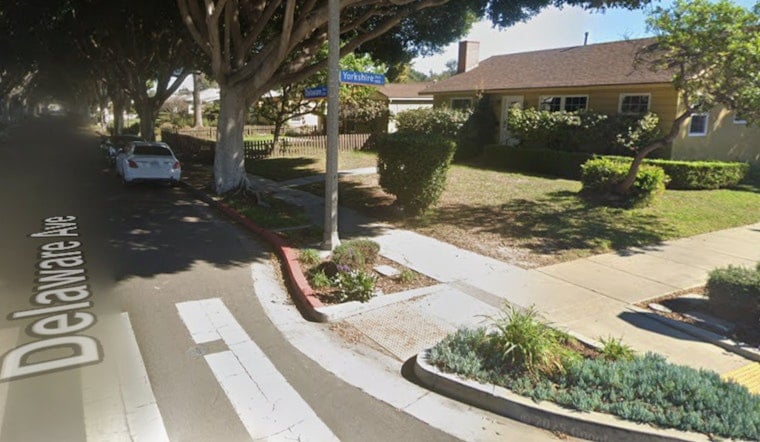
A single-family home built in 1949 on a corner lot in Santa Monica's Pico neighborhood could soon be demolished to make way for five three-story townhomes, in what developers say is the city's first housing application to invoke California's new SB 79 transit law. The project at 2904 Delaware Avenue, dubbed Delaware House, would replace the 1,051-square-foot house with 9,916 square feet of new residential floor area just north of the I-10 freeway and within walking distance of the Bergamot Station E Line stop.
The application was filed with the Santa Monica Community Development Department under the name Ficus Forest, LLC, with Eric Silverberg listed as the property owner applicant, according to Urbanize LA. The publication reports the townhomes are being designed by Open Office and would be clad in stucco, metal, and wood, per the project plans, with each of the five units including three bedrooms and one dedicated at-grade parking space. The parcel itself was purchased in June 2025 for $1,631,000, according to property records reviewed by Zillow and the LA County Assessor.
How SB 79 Changes the Math
The project's scale is only possible because of California Senate Bill 79, the Abundant and Affordable Homes Near Transit Act, which Governor Gavin Newsom signed into law in October 2025 and which took effect statewide on July 1, 2026. The law, according to the California Department of Housing and Community Development, overrides local height, density, and floor-area limits for qualifying projects near major transit stops, requiring cities to permit multi-family transit-oriented housing near high-frequency rail and transit corridors. Per Urbanize LA, SB 79 provisions allow the Delaware Avenue building to exceed the density and floor-area limits that would otherwise apply under Santa Monica's local zoning code.
The developer hosted an online public community meeting on August 12 to introduce the proposal to nearby residents and field feedback ahead of formal city administrative actions, according to Santa Monica Next. Neighborhood meetings of this kind are a required part of early project outreach in Santa Monica, the outlet notes. The developer also maintains a public project portal outlining a targeted opening date in 2028.
Skipping On-Site Affordable Units
Because the project proposes five units, it can satisfy the city's affordable housing mandate without building any income-restricted units on site. Under Santa Monica's Affordable Housing Production Program, multi-family developments of five units or fewer can pay an in-lieu fee instead of constructing dedicated affordable housing, with that fee set at $52.69 per square foot for condominiums as of late 2025, according to the City of Santa Monica Housing Office. Those in-lieu fee revenues are directed to the city's affordable housing trust fund to support affordable projects elsewhere. The developer is also seeking a subdivision tract map to establish the five units as separate airspace condominiums.
That compliance path highlights a broader tension in how Santa Monica is meeting its housing obligations. For the current Regional Housing Needs Allocation cycle running through 2029, state regulators mandated the city accommodate 8,895 new housing units, with 69% designated for lower- and moderate-income households, according to the City of Santa Monica. Even as market-rate projects like Delaware House rise under state transit mandates, the city has separately advanced plans for nearly 2,000 affordable units on municipal sites, including a 707-unit affordable housing master plan on the nearby Bergamot Station Arts Center property, as Hoodline previously reported.
A Statewide Pattern Near Transit Lines
Santa Monica's city council has already been grappling with how to reconcile local land-use control with the new state mandate. In July, council members considered zoning code updates and temporary parcel exclusions meant to align local rules with SB 79 while protecting specific neighborhoods within half a mile of the Metro E Line, Hoodline reported at the time. Delaware Avenue's proximity to the Bergamot Station stop places it squarely inside the zone SB 79 was designed to unlock.
Santa Monica is far from alone in confronting this shift. Since SB 79 took effect, developers across California have filed applications for transit-oriented infill projects in suburban and single-family areas, triggering pushback and legal battles in jurisdictions including San Francisco, Atherton, and Palo Alto, according to the same Hoodline reporting. Housing advocacy groups have sued cities that attempt to carve out large exemptions from the state's transit zoning law, underscoring how contested this new legal terrain remains as Delaware House moves through Santa Monica's entitlement process.


