

























































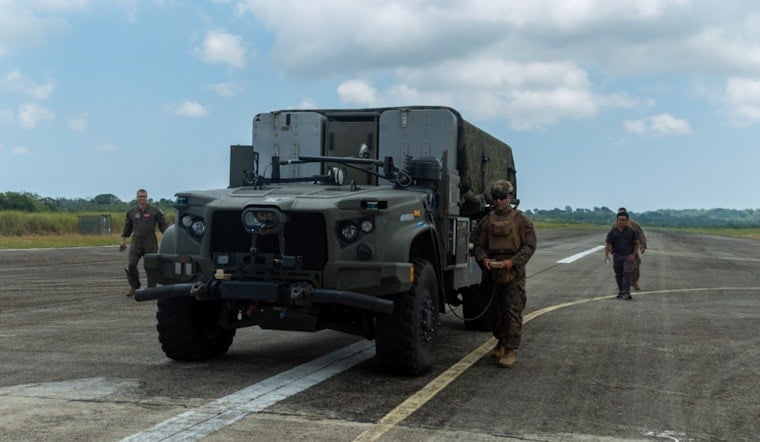
The Marine Corps has quietly bulked up its fleet of unmanned, shore-based missile launchers, handing Oshkosh Defense both a major production order and a separate development contract this week. The buys speed up fielding of ROGUE-Fires carriers, which are Joint Light Tactical Vehicles turned into crewless missile trucks, and push the NMESIS concept closer to a permanent maritime strike tool. Together, the two awards total about $92 million in fresh funding.
Contracts, Dollars And Deadlines
The new awards show up in a federal contracts bulletin as a $70,623,709 hybrid delivery order for procurement and a separate $21,456,092 RDT&E delivery order to Oshkosh Defense. According to the Department of Defense, most of the work will take place in Oshkosh, Wisconsin, with engineering efforts in Virginia, Maryland and Pennsylvania, and is scheduled to run through September 2028. The notice also spells out the funding accounts and contracting offices behind the sole-source delivery orders.
What The Vehicles And Missiles Can Do
As described by The Defence Blog, the ROGUE-Fires carrier essentially removes the crew cab from a Joint Light Tactical Vehicle and replaces it with sensors, cameras, communications gear and a multi-cell launcher that can be tele-operated or run in leader-follower and autonomous modes. The launcher fires Kongsberg’s Naval Strike Missile, and Kongsberg’s product page lays out the missile’s technical data and performance. The NSM carries an approximately 125-kilogram warhead, with the manufacturer advertising a range beyond 300 kilometers, which puts over-the-horizon coastal targets well within reach.
Already In The Pacific
The system is no longer just a science project. Initial NMESIS fire units went to the 3rd Marine Littoral Regiment in November 2024, and launchers were flown into the Batanes Islands during forward exercises in spring 2025. Those early fieldings and the Balikatan emplacement were reported by USNI News. For Marine planners, those deployments are a preview of the kind of distributed, island-based sea-denial posture they have been sketching on whiteboards for years.
Why The Marines Are Buying Them
The purchases plug directly into the Corps’ Force Design overhaul and its push for small, dispersed forces on islands that can complicate an opponent’s naval operations. Acquisition reporting shows the service intends to field roughly 261 NMESIS launchers in multiple batteries by decade’s end, according to ArmyRecognition. Analysts say the mix of procurement and RDT&E money is a telltale sign that the program is shifting from pure experimentation to steady, planned production.
What’s Next
The RDT&E funding is aimed at maturing hardware and software for a Block II vehicle that can keep operating in contested, communications-degraded environments while autonomy vendors and prime contractors fuse driving and mission software. Axios reported that Kodiak AI and other autonomy companies have been tapped to equip ROGUE-Fires with commercial autonomy stacks, a move that could accelerate remote operation and leader-follower modes. Taken together, the new production and development awards signal that the Marine Corps is moving NMESIS from PowerPoint concept to a standing, island-based strike capability.


.jpg)