

























































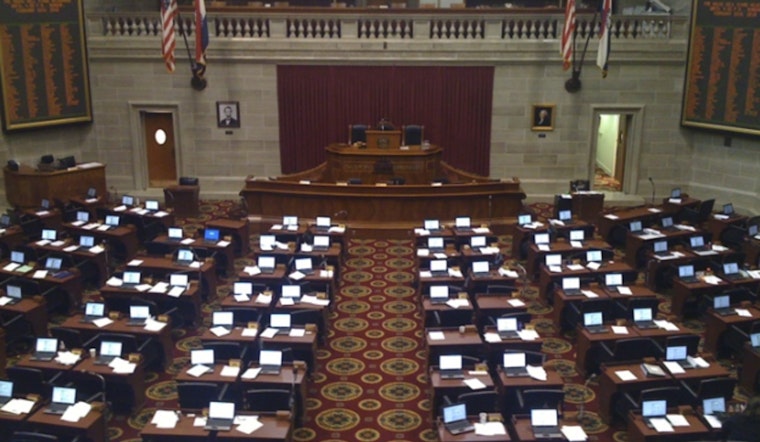
In Jefferson City, a high-stakes fight over how Missouri teaches kids to read is coming down to one brutal line in the law: if a third grader fails a statewide reading test, they repeat the grade.
Lawmakers pushing the bill say that kind of hard stop will finally force families and schools to act when students fall behind. Educators counter that mandatory retention could do real damage to children without fixing the instruction that failed them in the first place.
The House approved the measure in March, and the proposal is now before the Senate, where committee hearings and testimony have stretched into April and May. At the center of the fight is a question with big classroom consequences: should Missouri copy pieces of Mississippi’s recent reading “miracle,” or let its own new training and intervention efforts run longer before adding a third-grade gate?
What HB 2872 would require
House Bill 2872, sponsored by Rep. Cathy Jo Loy, would put a single, state-selected reading diagnostic in place for students in kindergarten through third grade. With only narrow exemptions, students who do not meet the benchmark at the end of third grade would be retained.
According to house.mo.gov, the House voted to pass the bill on March 12 and sent it to the Senate for further consideration. The proposal also calls for earlier notification to parents and requires intensive catch-up plans for students who are identified as falling behind in reading.
Lawmakers point to Mississippi's turnaround
Supporters frame HB 2872 as one part of a broader accountability push and point to Mississippi’s sharp gains in early reading scores as evidence that the approach can work.
Rep. Kem Smith, a Democrat from Florissant, told St. Louis Magazine she initially opposed the idea, then changed her mind after seeing how the threat of retention in Mississippi appeared to spur both schools and families into action.
Analysis by the Urban Institute shows that when NAEP scores are adjusted for student demographics, Mississippi now ranks near the top among states. Backers of HB 2872 regularly cite that data point as a reason Missouri should follow at least parts of Mississippi’s playbook.
Educators say it’s premature
District leaders who testified against the bill told lawmakers that Missouri is already in the middle of a shift toward phonics-based reading instruction. In their view, retention would punish students for adult decisions and instructional gaps instead of solving the underlying problem.
"Retention will mean forcing kids to get the same instructional content that didn’t work the first time," Christina Sneed, the School District of University City’s curriculum and instruction leader, testified, as reported by St. Louis Magazine.
Superintendents at a Senate hearing also warned that the policy could disrupt momentum from recent teacher training and expanded screening work, according to Missourinet.
Missouri already invested in training
Backers of HB 2872 argue that the bill would build on changes that are already underway, not replace them. A 2022 literacy law and the Department of Elementary and Secondary Education’s Read, Lead, Exceed initiative are aimed at scaling up evidence-based instruction and strengthening teacher training statewide.
Materials from the Missouri Department of Elementary and Secondary Education note that since 2022 the state has expanded LETRS training for educators and increased both screening and intervention supports for struggling readers. Supporters say retention on its own, without those kinds of structures, would be unfair to students and teachers. Critics respond that those same supports need more time to show results before the state adds a high-stakes retention rule on top.
What the evidence shows, and what it doesn't
Even in Mississippi, there is no clear agreement on how much test-based retention itself drove the state’s reading gains.
In a new report for the Progressive Policy Institute, Rachel Canter argues that Mississippi’s improvement grew out of a long run of policy changes across standards, accountability, instruction and on-the-ground implementation, not from retention alone. Other analysts and local reporters have highlighted years when more students were held back and raised concerns about selection effects. Statistical critiques and local coverage have pointed out that retention rates rose to a peak in some years, then fell in others, which complicates efforts to credit any single policy change.
For readers who want to dig into the research and debates behind Mississippi’s numbers, background is available from the Progressive Policy Institute, the Statistical Modeling blog and reporting by Mississippi Today.
What's next in Jefferson City
After clearing the House, HB 2872 moved to the Senate Education Committee, where members have continued to take public testimony and could revise the bill before sending it to the full Senate.
The House roll call and bill history are available through LegiScan, and committee hearing coverage has been provided by Missourinet. Lawmakers from both parties say they expect more floor debate in the weeks ahead.
The stakes for classrooms
Behind the policy language is a concrete question for Missouri classrooms: how to balance higher standards and accountability with the daily work of teaching young children to read.
Governor Mike Kehoe has already called for an A–F school grading system that would connect several accountability tools, a plan outlined in his Missouri Secretary of State filing for Executive Order 26-01. At the same time, the state’s largest teachers association has publicly raised concerns about HB 2872 and related measures in its legislative updates, including coverage from Missouri NEA.
For parents and educators in St. Louis and across the state, the open question is whether pairing tougher accountability rules with more training and support will help more students become confident readers, or whether mandatory retention will simply put another barrier in front of children who already need better instruction and more resources.





