

























































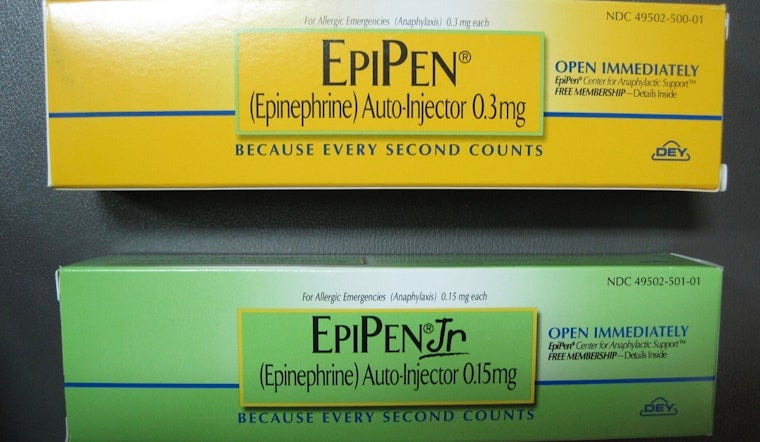
The days of hoping someone has an EpiPen in their backpack are officially over in New York City schools. Local Law 2 took effect on May 3, 2026, and it now requires schools and school-based child care programs to keep epinephrine devices on site for rapid treatment of severe allergic reactions. The mandate covers Department of Education schools, charter schools, nonpublic primary and secondary schools, and child care programs regulated by the city's Department of Health and Mental Hygiene. City officials have framed the move as a straightforward way to make lifesaving treatment available on the spot when students or staff go into anaphylaxis.
What the law requires
The ordinance, filed as Int. 895‑A and recorded as Local Law No. 2 of 2026, adds a new section to the administrative code that requires at least one epinephrine device in each school premises and at least two devices in each child-care facility, according to the New York City Council. When the 120-day waiting period ran out, the Council stamped the measure as “NOW IN EFFECT” on its official X account and posted the update on May 3, 2026; that announcement is available on the City Council's X account.
Training and legal framework
State law spells out how schools and child-care programs can legally stock and use epinephrine. New York Public Health Law §3000‑c authorizes non-patient-specific prescriptions, requires that designated staff complete approved training, and sets rules for storage and disposal of the devices. On the education side, the Department of Education’s health guidance says school nurses and other trained staff may administer epinephrine in emergencies under Chancellor’s Regulation A‑715, and families are urged to keep Medication Administration Forms up to date, according to the NYC Department of Education.
Why advocates say this matters
Allergy advocates have long warned that minutes can make the difference in a severe reaction, and they are treating the new law as a citywide safety net. The Elijah‑Alavi Foundation, which has pushed for stronger protections after high-profile child deaths from anaphylaxis, praised the Council’s move and framed it as building on earlier state efforts to keep kids from dying of preventable allergic reactions, according to the Elijah‑Alavi Foundation. Supporters say faster access to epinephrine, combined with trained staff who are not scrambling to find a prescription, can be lifesaving. At the same time, they note that the details of implementation, such as training schedules, how devices are stored, and who pays to replace expired injectors, will determine how smoothly the rollout goes.
What parents and schools should expect
For schools, this is not a “buy it and forget it” situation. Administrators will need to inventory their devices, track expiration dates, designate and train staff, and arrange standing orders or prescriptions that comply with state law. Parents and guardians are being urged to review their child’s Medication Administration Form, confirm that allergy information is current, and talk with the school nurse about individualized allergy action plans. For anyone looking to dive into the fine print on training, device rules, and legal protections, the key documents are the Council’s legislation and the state public-health statute linked above.




.JPG)