

























































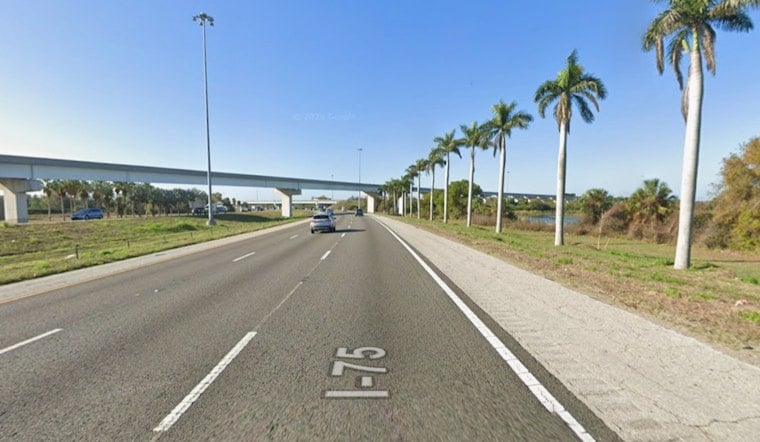
A 25-year-old Orlando man was killed early Thursday when his car left Interstate 75 in Palmetto and slammed into a support column beneath the I-275 overpass, in what troopers are calling a single-vehicle crash still under investigation.
The collision happened shortly after midnight on a curve near mile marker 228, according to responding troopers. State investigators are working to piece together what went wrong in the final moments before the car left the roadway.
Florida Highway Patrol investigators, as reported by Tampa Bay 28, said the driver failed to negotiate the curve, drove off the highway and crashed into the overpass column at about 12:30 a.m. He was pronounced dead at the scene. Authorities have not released his name or any additional identifying information.
Where it happened
The wreck occurred on a stretch of I-75 that cuts through Palmetto in Manatee County near the I-275 interchange. It is the kind of busy connection where tight curves and limited recovery space leave very little margin for error.
Transportation researchers have long flagged those conditions as high risk for run-off-road crashes. Work published on ScienceDirect notes that curves combined with narrow shoulders and constrained roadside areas can increase both the likelihood and the severity of crashes.
Why run-off-road crashes are so deadly
When a vehicle leaves the roadway, what it hits next often decides whether people walk away or do not survive. Collisions with fixed objects such as bridge columns, poles and trees make up a significant share of U.S. traffic deaths, according to the Insurance Institute for Highway Safety.
These crashes are especially violent because the vehicle is typically traveling at high speed into a rigid, narrow object with almost no space for the car to deform around occupants. IIHS reports that collisions with fixed objects remain among the deadliest crash types on American roads.
What engineers and drivers can do
Highway engineers have a toolkit meant to prevent exactly this kind of tragedy. Agencies deploy brighter and more frequent curve warning signs, rumble strips to alert drifting drivers, high-friction pavement to improve grip on curves and clear zones that remove or shield hard roadside obstacles.
In Florida, community traffic safety programs fold those engineering fixes into a broader mix of enforcement and education under the state’s “Target Zero” initiative, which aims to drive traffic deaths as close to zero as possible. FDOT outlines these countermeasures along with local outreach strategies designed to cut down on lane-departure and fixed-object crashes.
The Florida Highway Patrol continues to investigate Thursday’s fatal crash and has not released further information. Tampa Bay 28 has indicated it will update its coverage as additional details become available.





