

























































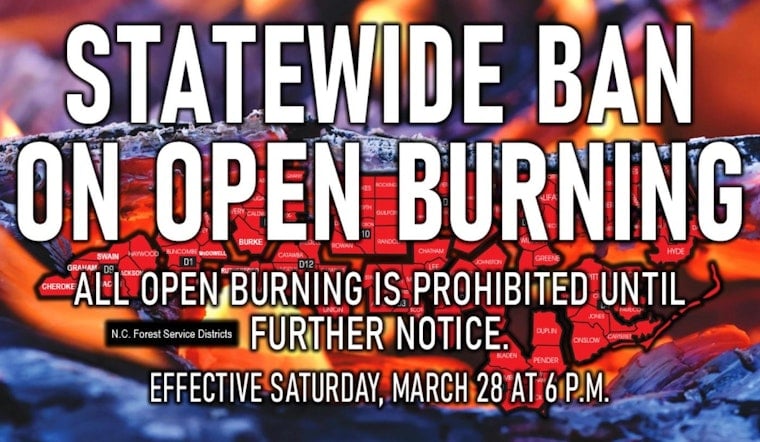
A well-timed dose of midweek rain has done what weeks of dry weather could not: it convinced state officials to pull the plug on the last piece of North Carolina's outdoor burn ban, including the Charlotte metro. The N.C. Forest Service announced Thursday that the ban was lifted for the final 19 counties, meaning permitted yard and debris burning can resume across much of the Piedmont. The fine print still matters, though, with residents reminded that local rules remain in force and burn permits are required anywhere the statewide order has been lifted.
Which counties were still under the ban
The final counties waiting on relief were Alamance, Anson, Cabarrus, Chatham, Davidson, Davie, Forsyth, Gaston, Guilford, Iredell, Mecklenburg, Montgomery, Moore, Randolph, Rockingham, Rowan, Stanly, Stokes and Union. "The recent rainfall has provided some relief and has moderated fire danger enough for us to lift the ban," Agriculture Commissioner Steve Troxler said. The change was outlined by the N.C. Forest Service.
What changed this week
By Thursday, state officials said the remaining statewide restrictions would also come off after additional rainfall, clearing the path for counties that had been under the ban to resume permitted burning. The update was reported May 7, 2026, by Queen City News, which cited public information from the N.C. Forest Service about the decision.
Limits remain: permits, the 100-foot rule and local control
The lift does not apply to fires started within 100 feet of an occupied dwelling, and local fire marshals still have the authority to issue or enforce burn bans inside that zone. Burn permits are required in counties no longer under the statewide order, and any permits granted before the March ban were canceled and must be reissued before new burning can begin. The original statewide order also spelled out potential penalties and liability for escaped fires and suppression costs, as detailed by the N.C. Forest Service.
Drought picture behind the scenes
The U.S. Drought Monitor map for May 5 (released May 7) still shows large portions of North Carolina in D3, labeled "extreme drought," with pockets of D4, or "exceptional drought," around parts of Union and Stanly counties, meaning conditions can deteriorate quickly without sustained rain. That ongoing drought backdrop is why officials caution that the lift is conditional and could be reimposed if dry, windy weather returns, according to the U.S. Drought Monitor.
How to proceed if you live in the Charlotte area
If you live in Mecklenburg or a neighboring county where the state ban has been removed, you need to obtain a valid burn permit from an authorized permitting agent before lighting any outdoor fire and keep a charged water source and tools close by. Local fire marshals can still set stricter rules or maintain a local ban, so residents are urged to check their county fire marshal page and the N.C. Forest Service county contacts for the exact steps. Local reporting confirms that permits are again available in counties no longer under the state ban, according to WUNC.
Even with the lift in place, fire risk has not disappeared. Keep burn piles small, stay with any fire until it is completely cold and be ready to call 911 if a fire starts to escape. Questions should go to your county fire marshal, and it is worth checking the forecast twice before you strike a match outdoors.




