

























































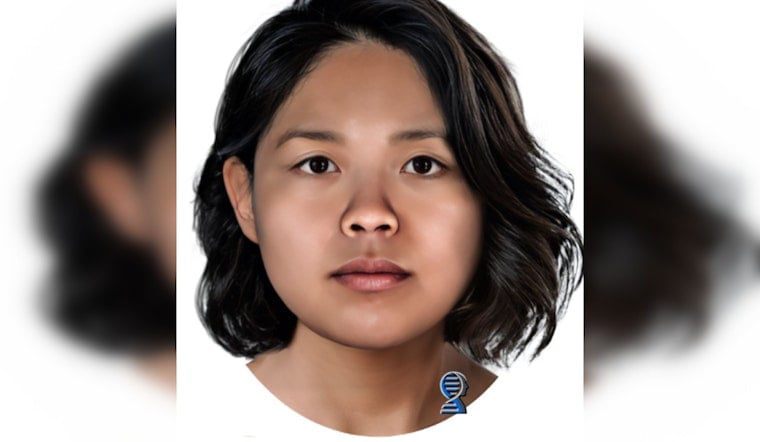
More than 30 years after a woman’s body was found in the open desert off the I-10, Riverside County investigators are taking another run at putting a name to “Desert Doe” with the help of modern DNA tools and a new forensic image.
On Tuesday, the county’s Regional Cold Case Homicide Team released an updated forensic image and ancestry profile as they renewed their plea for the public’s help. The woman’s remains were discovered on Oct. 20, 1994, by Southern California Edison employees on Eagle Mountain Road, about a half mile north of the I-10 in Desert Center. At the time, investigators could not identify her, and fingerprint and dental checks came up empty.
According to a press release from the Riverside County District Attorney's Office, bone samples were re-examined in 2023 using advances in forensic science, including forensic investigative genetic genealogy. A DNA profile was uploaded to a consumer ancestry database, and investigators used the resulting leads to commission a photo rendition and an ancestry-based profile in 2024. That work suggests the woman was of Southeast Asian descent, with brown eyes, black hair and a light brown complexion.
Back in 1994, investigators estimated the victim’s age at 25 to 35 years old. She was believed to be about 5 feet to 5 feet 2 inches tall and to weigh roughly 130 to 150 pounds, with shoulder-length brown hair. She was also described as wearing a yellow metal chain with a medallion shaped like a ship’s wheel with an anchor in the middle, details outlined by authorities and reported by CBS News Los Angeles.
How investigators used genetic genealogy
The technique investigators turned to, often called forensic or investigative genetic genealogy, creates an SNP-based DNA profile from bone or tissue and compares it with publicly available genealogy databases to identify potential relatives and narrow identity leads. According to the U.S. Department of Justice, the method is meant to generate investigative leads only after traditional searches have been exhausted, and it comes with privacy and procedural safeguards for law enforcement.
How to help
Riverside County officials are hoping the updated image, ancestry clues and a distinctive piece of jewelry will jog someone’s memory. Anyone who might recognize the medallion, recall a missing family member who matches the description, or have other information is asked to contact the cold case unit. Investigators provided a tip line, Investigator Ebony Caviness at (951) 955-0257, and an email, [email protected], as reported by CBS News Los Angeles.
Forensic science reviews note that investigative genetic genealogy has helped produce scores of identifications in long-cold cases nationwide, even as researchers and policy makers continue to weigh privacy and ethical questions. A recent review in Forensic Sciences Research outlines the technique’s strengths and limits and emphasizes that genetic leads must still be backed up by traditional investigative work.





