

























































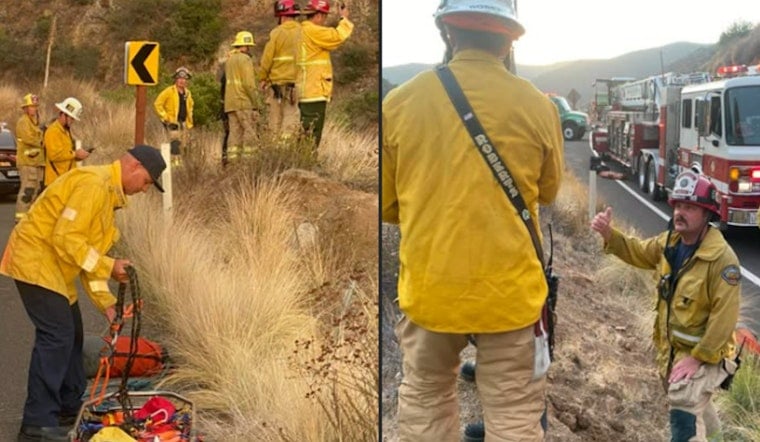
A driver who went over the side on Ortega Highway was pulled from a steep embankment Tuesday by Orange County firefighters, who navigated rugged terrain to reach the vehicle before hauling the patient back up to the roadway and rushing them to a local hospital.
Orange County Fire Authority crews responded to the vehicle-over-the-side incident on the mountain pass, according to a post from Orange County Fire Authority on Facebook. The agency said its crews navigated challenging terrain to reach the vehicle, returned the patient safely to the roadway, and rescued them before one patient was transported to a local hospital. OCFA titled the post “All-Risk. Anywhere. Anytime.,” a nod to the kind of rugged, unpredictable rescue work its crews routinely handle on the corridor.
Following the rescue, OCFA advised mountain-road travelers to slow down, stay alert, and expect changing road conditions — a warning that echoes the agency's repeated calls for caution along one of Orange County's most treacherous stretches of highway.
A Mountain Pass With a Deadly Reputation
Ortega Highway, or State Route 74, is a narrow, two-lane mountain pass connecting Orange and Riverside counties through the Cleveland National Forest, and this kind of vehicle-over-the-side rescue is far from an isolated event on the corridor. Its narrowest and curviest section, roughly 14 miles east of Interstate 5, was historically dubbed “Ricochet Alley” by California Highway Patrol officers because of sheer canyon walls on one side and deep ravines on the other, according to the Los Angeles Times.
Just months ago, a 23-year-old Menifee resident was killed when his car veered off westbound Ortega Highway near Main Divide Truck Trail and plunged down a steep hillside embankment on April 30, an incident Hoodline previously reported required an extensive multi-agency effort to clear the scene. That crash underscored how frequently vehicles veer off the roadway and tumble down steep embankments on this stretch, requiring the kind of specialized technical rope-rescue operations OCFA's heavy rescue teams are trained to perform.
Specialized Rescue Teams Built for Steep Terrain
OCFA maintains four specialized Technical Rescue Teams staffed daily across Orange County, equipped with heavy rescue trucks and specialized rope systems designed for complex steep-terrain and vehicle-over-the-side extrications, according to reporting from FOX 11 Los Angeles. That kind of equipment and training becomes essential on a corridor where sheer drops and limited shoulder space leave little margin for error when a vehicle leaves the roadway.
Collision data underscores just how dangerous this stretch of highway is. An analysis of California Highway Patrol collision records from 2024 to 2025 identified Ortega Highway, along with Santiago Canyon Road and Laguna Canyon Road, as the three most dangerous roadway corridors in Orange County, per Kubota & Craig. Statewide traffic records covering 2019 through 2023 separately ranked State Route 74 as the second deadliest corridor for motorcyclists in California, recording 90 severe or fatal crashes over that five-year span, according to Bana Law.
Road Work Underway, But Hazards Persist
State and county agencies have been working to address the corridor's dangers. Caltrans and Granite Construction are currently executing an $88 million to $96.1 million safety project near Lake Elsinore that will widen lanes to 12 feet, add four-foot shoulders, and install centerline and edgeline rumble strips, with construction targeted for completion by late 2026, according to Caltrans project documentation. Orange County has also folded State Route 74 into its Countywide Local Roadway Safety Plan, which evaluates engineering countermeasures such as speed calming, shoulder widening, and enhanced visibility signage to reduce run-off-road collisions in unincorporated mountain areas. California Highway Patrol traffic safety reports attribute the majority of severe collisions along the 33-mile Ortega Highway pass to unsafe vehicle speeds, improper turns, and unsafe lane changes, which has prompted ongoing grant-funded CHP enforcement campaigns across the corridor, per the California Office of Traffic Safety. Even so, ongoing construction operations, intermittent lane closures, and limited shoulder availability continue to contribute to run-off-road incidents on the pass, reinforcing why OCFA keeps repeating its message for drivers to slow down and stay alert.
Orange County has also invested in emergency infrastructure built specifically for this remote corridor. Rapid-refill HeloPod infrastructure was dedicated in late 2023 on Ortega Highway in San Juan Capistrano to improve aerial fire support response times, a project Hoodline detailed in its report on the OC helicopter refill station. The corridor's hazards aren't limited to traffic collisions; during the September 2024 Airport Fire along Ortega Highway, first responders executed a dramatic rescue on SR-74 when a Cal Fire Riverside battalion chief pulled a severely burned civilian from active wildfire flames near El Cariso Village, according to the Los Angeles Times.
No further details on the condition of the patient rescued Tuesday or the circumstances that led the vehicle to go over the side have been released.



